Goexme is a smaller instant crypto exchange brand operating in a crowded part of the market. It presents the familiar promise: swap digital assets from one wallet to another without opening a full trading account. That proposition is easy to understand, but it also creates a problem for the reviewer. There are dozens of sites offering almost identical flows, and a newer or less documented provider has to earn trust rather than assume it.
The basic process is conventional. A customer chooses a pair, enters a receiving address, receives a deposit address, and waits for the converted coins to arrive. There is no order book and no reason to leave a long-term balance with the service. That is convenient for a quick conversion, particularly for users who do not want to move assets through a major centralized exchange for every small trade.
Goexme's interface is reasonably approachable, but its public footprint is much thinner than that of established providers such as LetsExchange, ChangeNOW, or FixedFloat. A simple interface is not a moat. The real questions are who provides liquidity, how exchange quotes are constructed, what happens during an exception, and whether there is enough independent evidence of reliable handling over time. Goexme does not answer those questions as convincingly as a mature service.
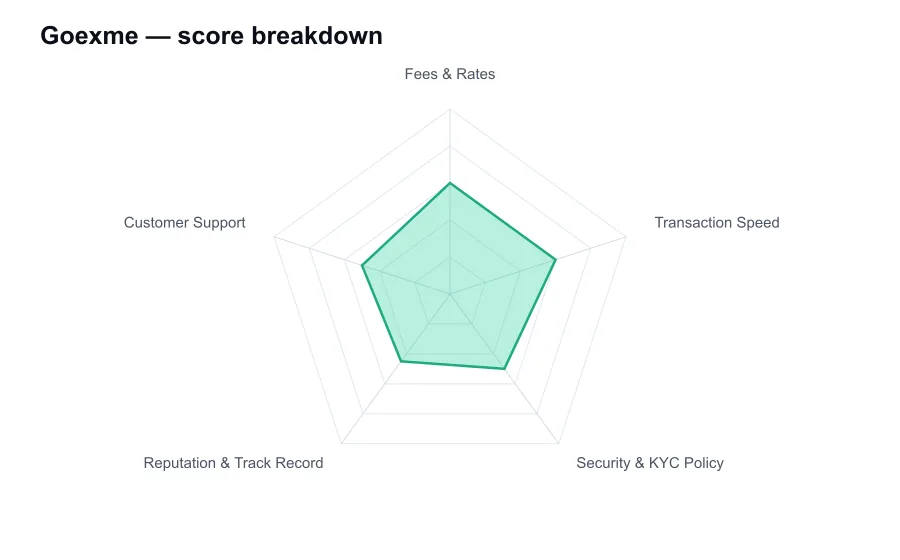
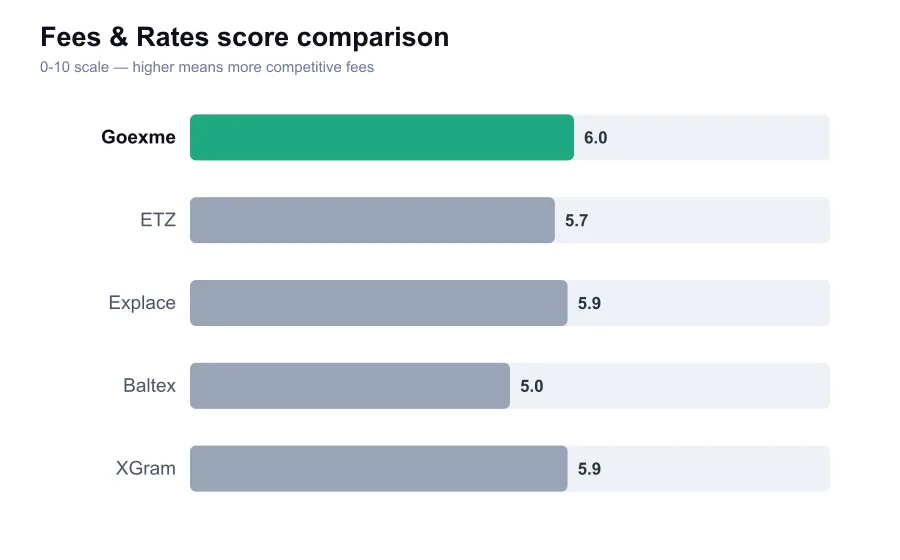
Fees are the first area where that limited transparency matters. Like many swap platforms, Goexme presents a final exchange quote rather than a clean, universal trading fee schedule that applies to all pairs. This can be perfectly legitimate, since liquidity and network fees vary. It also makes price comparison essential. A service can advertise competitive pricing while earning through spread embedded in the rate.
I would not send funds based on a headline claim alone. Compare the actual amount you will receive with a known competitor at the same moment, using the same network and deposit size. Pay special attention to stablecoin routes. USDT on Tron may produce a very different result from USDT on Ethereum because network costs and available liquidity are different. A cheap-looking swap can stop looking cheap once those details are included.
Speed is similarly dependent on the route rather than the site logo. A liquid transfer involving Tron, Litecoin, or XRP may settle quickly after the inbound payment is recognized. Bitcoin can take longer, and Ethereum can be expensive or slow during congestion. Goexme cannot bypass confirmation requirements or chain conditions. Its user flow is simple, but there is limited public operational data that would justify calling it a speed leader.
The non-custodial label needs careful wording here. Goexme appears to use a transaction-based exchange flow rather than a wallet account that holds customer balances indefinitely. That reduces the risk of keeping funds parked on a platform. During the swap, though, the provider or its liquidity partner necessarily receives control of the deposit. A user is relying on the service to send the promised payout. That is counterparty risk, however brief the intended holding period is.
KYC is another area where users should avoid assumptions. Services in this category often permit ordinary swaps without registration, yet reserve the right to screen suspicious transactions and seek documentation. If Goexme's public presentation emphasizes privacy, that doesn't create a legal or practical guarantee that every transaction will proceed without a review. Anyone exchanging coins with a problematic transaction history, or moving a large amount, should expect that screening may occur.
I am more cautious about Goexme's security and reputation than I would be with a provider that has been extensively tested by a large user base. There is a difference between saying there is no known major incident and saying the provider has a strong security record. The first statement may simply reflect limited visibility. For a little-known exchanger, absence of public bad news is not the same as positive evidence.
That does not make Goexme automatically unsafe. Smaller services can offer good execution, attentive support, and useful routes. But trust should be proportionate to the evidence available. I would use a modest test swap before relying on it for anything meaningful. Verify the deposit address, record the order ID, and wait for a completed payout before deciding whether it belongs in your regular toolkit.
Customer support is especially important for lesser-known exchangers because users have fewer outside channels for escalation. A delayed order is irritating anywhere. With a major company, there may be years of reviews, public representatives, detailed help articles, and a legal entity that can be identified. With a smaller brand, a customer may have little beyond the platform's own contact form or chat channel. That is not enough comfort for a high-value transfer.
Goexme's support should therefore be judged conservatively until it has a deeper independently verifiable track record. Before making a large swap, test how quickly the team answers a basic pre-sale question. Ask about the exact network you intend to use or whether a memo is needed. A real answer from a knowledgeable person is more meaningful than a generic promise of around-the-clock assistance.
There are technical risks that apply with extra force here. Do not send assets from the wrong network. Do not assume wrapped tokens are interchangeable with native coins. Do not use an exchange withdrawal that may arrive after a quote expires unless the provider clearly explains how late deposits are handled. These errors are recoverable only sometimes, and a smaller operator may have fewer resources for manual recovery.
Goexme may suit a user who has found a clearly better live quote on a routine, liquid pair and is comfortable accepting the platform's limited history. That is a narrow recommendation, not a dismissal. The service is easy enough to use, but convenience is the minimum standard in this category. Until its public track record, company transparency, and independently observable support record become stronger, I would keep transactions small and treat better-known alternatives as the default.