MoneroBridge is a niche instant-exchange service focused on moving value into or out of Monero. That focus gives it a clear purpose. People who use XMR often find that large centralised exchanges either restrict the asset, remove it in certain jurisdictions, or force them through a more demanding account process than they want. MoneroBridge aims to fill that gap with a direct swap flow rather than an order-book exchange.
The service's appeal is obvious: choose a pair, provide an address, send the deposit, and receive the converted asset. For a Monero user, this is often less cumbersome than opening an account at a conventional exchange, completing verification, depositing funds, and later withdrawing. It is also a category where promises need to be examined closely. Privacy-oriented exchange services attract users precisely because transactions are difficult to reverse and disputes can be hard to resolve.
MoneroBridge should be judged as a brokered instant exchanger, not as a venue where customers are trading directly against a visible order book. The price you receive is a quote. It can include liquidity-provider costs, a spread, network expenses, and the operator's margin. This is normal, but a quote-based service has a duty to make the distinction between fixed and floating rates clear. A user who thinks they have locked a price may be unhappy if the output changes after the deposit confirms.
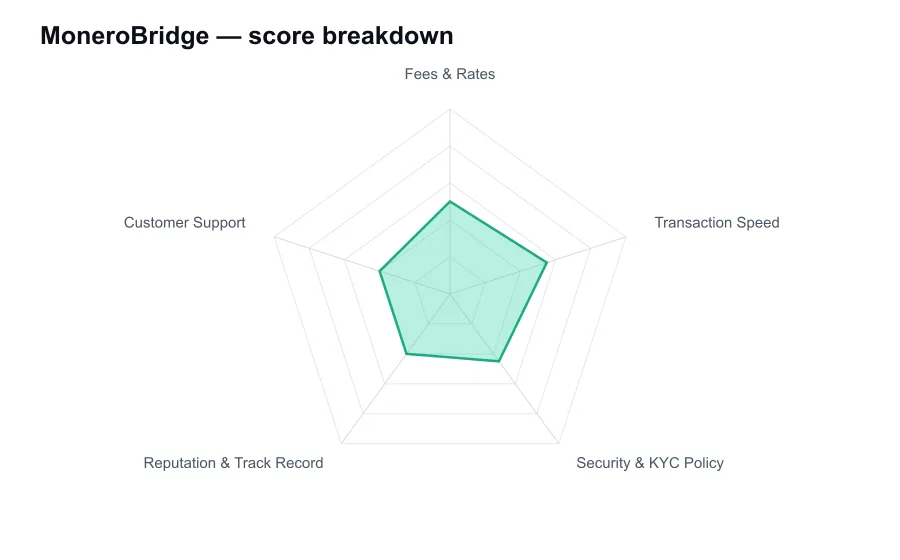
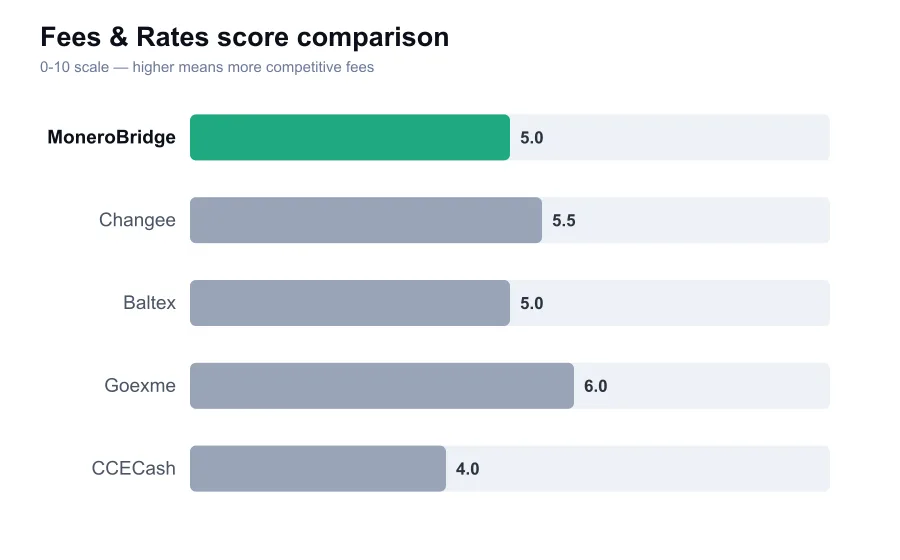
The service does not have the pricing transparency of a major centralised exchange with published maker and taker fees. Instead, the practical fee is the difference between the market rate and the amount shown at checkout, plus any chain fee deducted from the payout. That means users should compare the actual output, not search for a single headline percentage. For common pairs, checking MoneroBridge against a reputable alternative can take less than a minute and may save far more than chasing a nominally low fee.
Monero transactions have their own timing characteristics. XMR block times are roughly two minutes, but an exchange will usually wait for its chosen number of confirmations before it processes the order. The other side of the swap matters too. Bitcoin confirmation policies, Ethereum gas conditions, and liquidity-provider processing can all extend a transaction. MoneroBridge can be convenient, but no privacy-coin bridge should be treated like a card payment or a guaranteed instant transfer.
A sensible expectation is that a routine order finishes after the relevant deposit receives confirmations and a liquidity route is available. If the quoted order is floating-rate, market movement can also affect whether a provider needs to re-price or split execution. The difficult cases are deposits made with insufficient network fees, incorrect payment identifiers where relevant, tokens sent on the wrong network, or funds flagged by an automated compliance system. These are where a small operator's support quality matters most.
MoneroBridge's no-account style is attractive, but users should not confuse it with a guarantee of anonymity or an unconditional no-KYC promise. Services facilitating crypto conversions can screen addresses and can request identity or source-of-funds documents in particular cases. Monero is especially sensitive because several regulated exchanges have delisted it. If a provider reserves compliance discretion, that needs to be stated clearly enough that a customer understands the risk before depositing.
From a security standpoint, the good news is that a one-off exchange flow can reduce the risk of leaving a standing balance on a platform. The bad news is that the service still receives a deposit before sending the payout. The customer is exposed to counterparty risk during that interval. There is no substitute for a long, transparent history of handling exceptions fairly, publishing incident updates, and keeping a support channel responsive.
MoneroBridge has a more intelligible niche than many generic swap websites, but its reputation remains limited compared with established brands. It does not have the years of public scrutiny that a major exchange, or even an older instant exchanger such as ChangeNOW, has accumulated. That doesn't invalidate every successful order. It does mean the service has not yet earned the confidence needed for substantial transfers.
The absence of a deep public record changes how I would use it. I would not send the entire proceeds of a sale, a treasury balance, or funds needed for a deadline. I would run a small test in the exact direction and on the exact network I intend to use later. A BTC to XMR test does not prove that an XMR to USDT route will be equally quick, equally liquid, or subject to the same compliance checks.
Support is where small exchange services often disappoint. A polished interface can generate an address quickly. Explaining a missing payout, tracing a wrong-network deposit, or addressing a compliance hold takes people, records, and a clear escalation process. MoneroBridge should be expected to provide order-level assistance, but users should preserve all evidence and should not rely on chat alone for a meaningful dispute.
The operational details matter with Monero. Ensure that the destination wallet is properly synchronised, confirm that the wallet supports the address format you use, and wait for the receiving wallet to refresh before assuming a payout is missing. Monero's privacy design can make external transaction tracking less straightforward than tracing a Bitcoin transaction in a public explorer. That is a feature for privacy, but it can make support cases harder for newcomers.
There is a legitimate use case for MoneroBridge: an experienced XMR user who understands instant-exchange risks, wants a simple conversion path, and is working with a modest amount. It is less suitable for someone who needs audited custody, fiat access, an advanced order book, or the protections of a well-known regulated company. The service is a tool, not a bank.
My view is cautious rather than dismissive. MoneroBridge solves a real access problem for Monero users, and an account-light swap flow can be useful. Still, the privacy-coin niche makes transparency and responsive support more important, not less. Until it has a broader independent reputation and more detailed public operating disclosures, use it for limited transactions and keep stronger alternatives available.