Baltex is a smaller crypto exchange service aimed at users who want a direct conversion path rather than a large exchange account. It occupies a difficult part of the market. Instant exchangers are easy to launch and easy to describe, but trust is hard won because customers hand over funds before receiving the output. Baltex has a functional proposition, yet it does not have the brand depth, audited public history, or broad third-party visibility that puts a provider in the same confidence bracket as the established names.
The site is built around simple exchange actions. That is good product discipline. A customer who already has crypto does not need a complex terminal to swap between assets. Baltex presents a route, asks for a receiving address, and processes the conversion. It is an appropriate workflow for occasional users, especially those who keep their funds in personal wallets. It is not a venue for people who want limit orders, deep market data, tax reporting, or sophisticated portfolio controls.
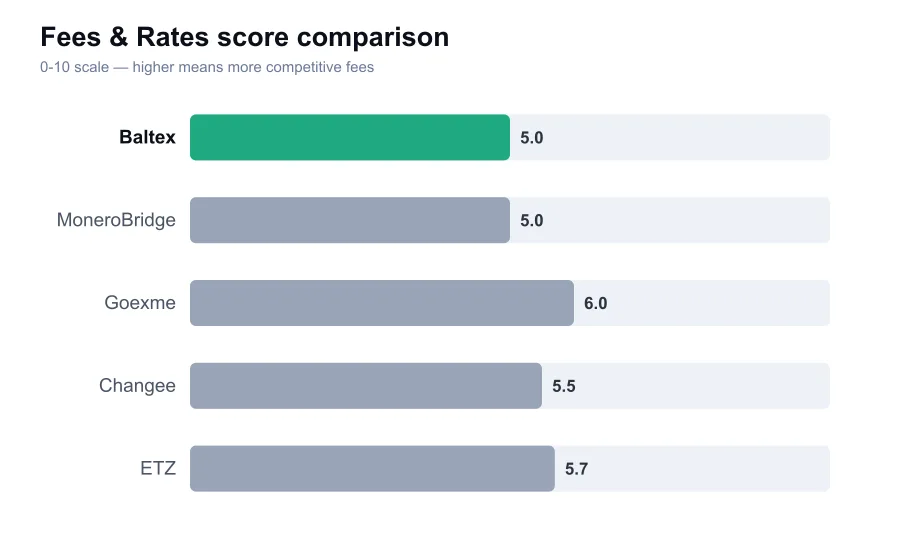
Pricing is the first area where caution is justified. Like many instant services, Baltex's cost is principally visible in the rate it offers rather than in a clean public trading-fee table. There is nothing inherently improper about that model. Network fees, liquidity costs, and risk all need to be reflected somewhere. The drawback is that a user cannot glance at a page and know whether they are paying 0.5 percent or several percent. The only sensible approach is to compare the final output on the exact pair and amount.
That issue becomes more important on low-liquidity assets. A swap involving Bitcoin, Ethereum, or a widely used stablecoin has more competing liquidity sources and tends to be easier to price. A niche token can carry a much wider embedded spread. The provider may still complete the order correctly, but the customer could receive meaningfully less than expected if they never checked alternatives. Baltex is not the service I would choose for price-sensitive conversions where a liquid centralized exchange is available.
Speed is acceptable for the product category, with an important qualification. The interface may create an order quickly, but actual completion depends on the incoming chain confirmation and the outbound asset's network conditions. Bitcoin can be slow during fee spikes. Ethereum can be slow and expensive when gas demand rises. Stablecoins may settle rapidly on some chains and less predictably on others. Baltex cannot control those blockchains, so treat any time estimate as operational guidance rather than a promise.
A smaller provider needs to be especially clear about exceptional cases. If a customer deposits the wrong amount, sends a token over an incompatible network, or triggers an automated risk review, the order becomes a support and reconciliation task. That is where larger competitors often have an advantage because they have more documentation, a bigger staff, and a deeper history of resolving edge cases publicly. Baltex does not provide enough public operational detail for me to regard it as a first choice for a large or urgent transaction.
Its security posture should be judged with realism. An instant exchanger can limit long-term custody risk because it sends the proceeds to a user-selected wallet rather than encouraging balances to sit on its platform. That is a genuine positive. However, temporary custody exists after you deposit and before it pays out. There is no way around that. Customers should therefore focus on provider transparency, order tracking, correct address handling, and support responsiveness instead of assuming that a wallet-to-wallet flow is automatically risk-free.
KYC is another subject where many users make bad assumptions. The absence of an account registration screen does not establish that a service is permanently no-KYC. Crypto businesses use transaction monitoring, and providers may seek documentation based on transaction patterns, payment method, source-of-funds concerns, or sanctions screening. Baltex users should be prepared for that possibility. If document submission would cause a serious problem, do not send funds first in the hope that the order will somehow remain outside compliance controls.
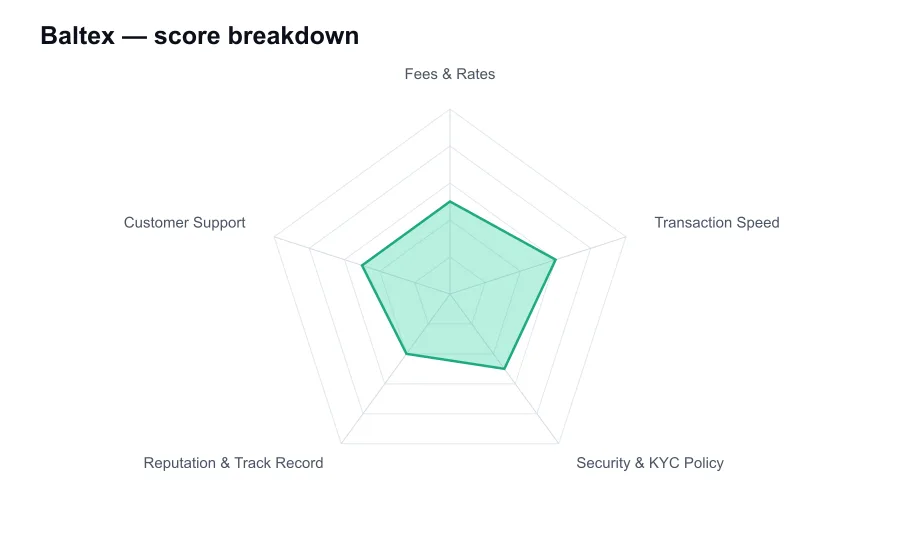
The reputation score is the main reason Baltex trails Alfacash and BitcoinVN in this comparison. I have not seen the breadth of independent operating history that would let me recommend it with the same confidence as a well-known provider that has weathered multiple market cycles. A smaller public profile is not proof of misconduct. It does mean there is less evidence to lean on. In crypto, limited evidence is a reason to reduce transaction size, not a reason to take a leap of faith.
Customer support is likely to matter more here than the polished front end. Before using Baltex for anything meaningful, test the support channel with a precise question about the pair, network, or expected processing flow. A competent reply is not a guarantee, but silence or vague answers are a useful warning sign. Should an order go wrong, provide a transaction hash and order reference immediately. Emotionally charged messages without the basic technical data rarely speed up a resolution.
Baltex can still serve a purpose for users who find a favorable route. Smaller exchangers sometimes list pairs or route combinations that larger services do not prioritize. If the displayed output is good and the amount is modest, that convenience can justify using it. I would keep the transaction simple, use a major asset on a clearly specified network, and avoid experimenting with obscure token contracts. This is not the place to test whether a support team can recover a complicated mistake.
Do not confuse an instant exchange quote with a trade executed on a transparent order book. With an order book, you can see bids, asks, depth, and often the fee formula. With Baltex, you are evaluating a package price and the provider's ability to honor it. That can be perfectly adequate for a quick swap, but it calls for a different standard of care. You need to inspect the output amount, network fee treatment, rate lock conditions, and expected confirmation requirements before committing.
For a routine small conversion, Baltex may be fine. I would define routine quite narrowly: an asset pair you understand, a receiving wallet you control, no deadline measured in minutes, and an amount whose temporary loss would not be disastrous. If any of those conditions is not true, choose a provider with more documented controls and a stronger public support record. Convenience has value, but it is not a substitute for operational confidence.
My final assessment is restrained. Baltex looks like a usable instant-exchange option, but it has not earned the level of trust I would give a veteran operator or a regulated exchange with extensive public disclosures. Its basic flow is straightforward and its non-account model can be attractive. The lack of transparent standardized pricing and limited independent reputation keep it in the lower middle tier. Use it only after comparing the quote, and keep first transactions small.