Nexchange is an instant cryptocurrency exchange and exchange-API provider rather than a conventional retail trading platform. It is built around automated conversion. A customer or an API partner selects a pair, receives a quote and deposit instructions, sends the asset, and receives the output. That makes it more comparable with service-layer providers such as Changelly or ChangeNOW than with Coinbase, Kraken, or an order-book exchange.
Its API orientation is important. Nexchange has historically positioned itself as infrastructure that wallets, brokers, payment products, and other services can integrate. That can be useful because an API-focused provider tends to think about order states, callbacks, rate endpoints, and transaction tracking. Those are operational necessities for a partner product. It also means that some users may encounter Nexchange through another app without immediately realising who is fulfilling the conversion.
The business model is quote-based. You do not place a bid on a public book or choose a maker order. You accept an offered conversion amount, then the service or its liquidity partners execute the route. The quote can contain an explicit fee, a market spread, network costs, or some combination of the three. This is not inherently bad. It is the normal economics of an instant exchange. It does make direct price comparison essential.
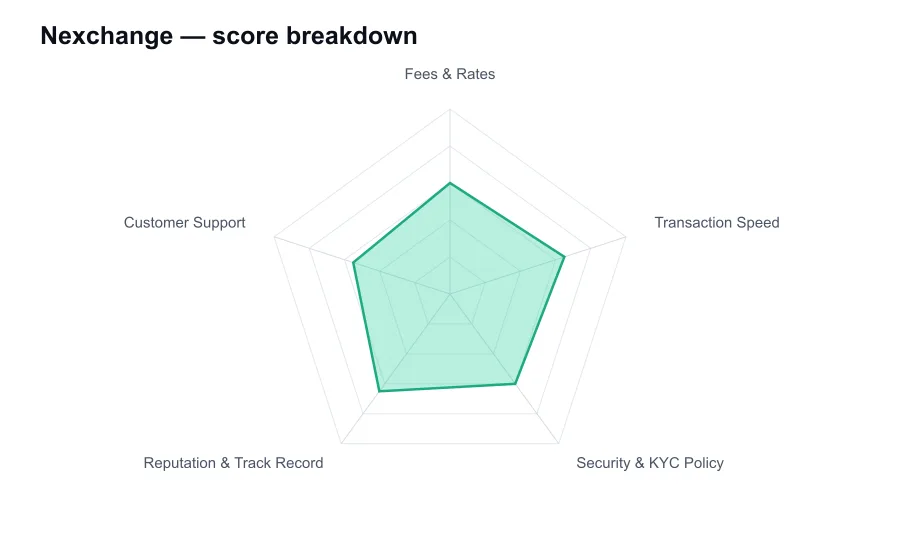
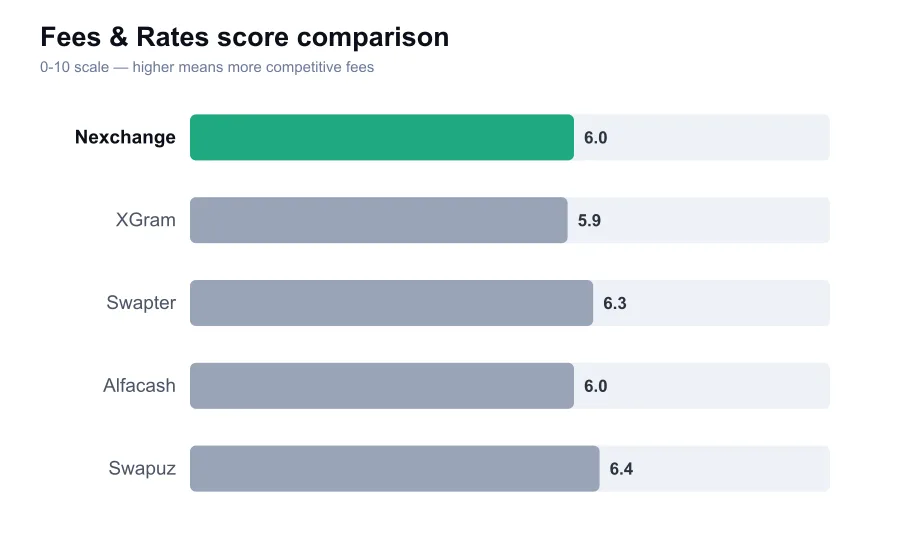
Nexchange has been associated with a 0.5 percent service fee in its public API materials, though users should treat any live quote and current terms as authoritative because providers can change pricing by pair, route, and integration. A 0.5 percent base charge is not outrageous for instant conversion, but it is not automatically cheap either. On liquid BTC, ETH, or stablecoin pairs, a self-directed trade at a large exchange can be substantially cheaper if you are willing to manage deposits and withdrawals.
The fee figure is only the start. Bitcoin and Ethereum network costs can dominate smaller trades, especially during congestion. A provider may pass those through directly, estimate them in advance, or deduct them from the delivered amount. A good comparison checks the final output after every deduction. For API partners, this is even more important because a partner could add its own margin on top of Nexchange's quote.
Speed is generally one of Nexchange's better characteristics, at least by the standards of a confirmation-dependent exchange service. Its system is designed to generate orders automatically and monitor blockchain deposits. Still, the processing clock starts with confirmation, not with the moment you press send. A Bitcoin deposit can take much longer than expected during fee spikes, while an Ethereum transaction with insufficient gas may sit pending. No exchange API can make a slow chain fast.
The right way to judge Nexchange's speed is through order status and communication. A mature instant-exchange flow should tell users whether an order is waiting for deposit, confirming, exchanging, sending, completed, or failed. That is much better than a vague spinner and it matters to partner services trying to support their own customers. Nexchange's technical orientation gives it an advantage here over anonymous swap pages with little visible order logic.
Security needs a clear-eyed reading. Nexchange is not the same as a non-custodial decentralised exchange. During an order, a customer transfers funds to an address controlled by the exchange process or a liquidity partner. The service then owes a payout. That temporary counterparty exposure is real. The positive side is that users are not expected to leave a long-term portfolio balance sitting in an account after the order has completed.
For an API provider, security also includes partner implementation. A wallet app integrating Nexchange must protect API credentials, validate callback data, display the correct deposit address, and handle expired quotes safely. An integration error can be just as harmful as an exchange-side outage. Retail users cannot audit those connections, but they can reduce risk by confirming that the displayed address and expected amount match the order details before broadcasting.
KYC should not be treated as a binary marketing label. Nexchange can support a streamlined order flow, yet transaction monitoring and legal compliance obligations can lead to a request for identification or source-of-funds information. This is common in the sector. The fair standard is whether a provider explains this possibility, asks proportionately, and provides a route for resolving a case without leaving a customer guessing. No user should route funds through a swap service if a surprise compliance review would cause serious harm.
Nexchange has a stronger reputation than a newly created swap site because it has operated as a known API and instant-exchange brand for years. Its public identity is still far less prominent than the largest retail exchanges, and it does not have their regulatory footprint or customer-service scale. But it has a more developed technical identity than many small providers, which counts for something in a business where backend competence is central.
Support is adequate in concept but can become complicated in practice because the customer may have two support relationships. If the swap was initiated inside a wallet or broker app, that app is often the first contact. Nexchange may need order data from the partner before it can investigate. Users should identify the actual order provider early, retain the transaction hash and order reference, and avoid sending duplicate deposits while waiting for an answer.
Nexchange makes most sense for users who value an integrated instant conversion route or developers evaluating exchange infrastructure. It is less compelling for a trader who wants advanced orders, transparent depth, low maker fees, fiat rails, or a regulated custodial account. For a straightforward swap, the final quote may be competitive. For repeated trading, a conventional exchange is usually the better economic tool.
My assessment is that Nexchange is a legitimate service category with a more credible technical profile than many obscure instant exchangers. Its API focus is a strength, but it also makes pricing and support more layered than they first appear. Use it for convenient, well-quoted conversions, especially through a trusted integration. Do not mistake convenience for zero counterparty risk, and do not accept a quote without checking what reaches your wallet.