ETZ is a crypto exchange and conversion service operating under a short, generic brand name that can be difficult to research cleanly. That alone matters. A provider handling irreversible crypto transfers needs a public identity, clear terms, and an easy way for a customer to verify who is responsible when something goes wrong.
The service is built around crypto exchange rather than an advanced trading terminal. Users select an exchange direction, provide a destination address, and complete the transfer through the quote presented by the service. It is closer to an instant exchanger than a full centralized exchange with limit orders and custody accounts.
Its appeal is convenience. There is less setup than at a major exchange, and users who only need to convert one asset do not have to learn a trading interface. For small, routine conversions, that can be a real benefit.
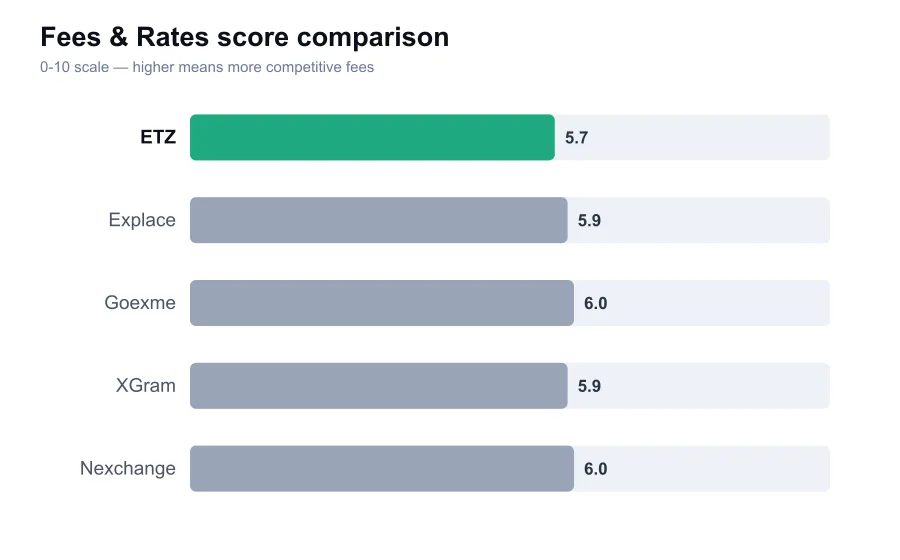
The pricing issue is the same one found across much of this segment, but ETZ gives users less room for confidence than better-known rivals. The final exchange rate includes the provider's margin, available liquidity, and network costs. Without a highly transparent public fee schedule, the only meaningful test is the output quote itself.
That means ETZ should not be used on price faith alone. Compare its payout against at least two alternatives before committing funds. If an exchange hides its economics inside a rate, it needs to win trust through consistently competitive quotes and clear order information.
Settlement speed depends heavily on the source chain. A stablecoin transfer on a low-fee chain can be fast, while Bitcoin or Ethereum during congestion can take much longer. ETZ cannot bypass block confirmations, and customers should be wary of any marketing language that implies every conversion is immediate.
A simple swap that has received its deposit confirmation can complete quickly. The more difficult reality appears with underpayments, overpayments, incorrect networks, missing memos, or a token sent to an unsupported contract address. Those are the situations where a provider's operations and support quality matter far more than its landing page.
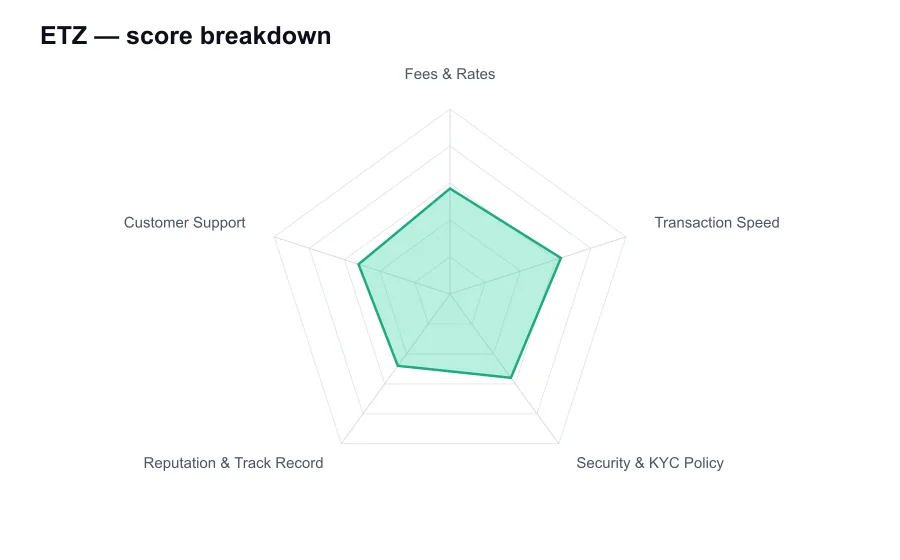
ETZ should be approached with a higher degree of caution than a widely documented, long-running exchange. Its public footprint is comparatively limited, and there is less independently verifiable information available about its operating history than there is for brands such as Kraken, Coinbase, ChangeNOW, or even Exolix.
That is not proof of misconduct. It is a reason to adjust behavior. The right response is not panic, it is risk control: keep transactions modest, test the route first, retain all records, and do not use an obscure provider as the sole bridge for funds you urgently need.
Like other services that facilitate crypto conversions, ETZ may apply transaction monitoring and ask for verification in selected cases. Users should not assume that an account-free starting flow means a legally irreversible promise of anonymity. Compliance checks can delay access to funds, particularly where a transaction is flagged by automated screening.
The security model is therefore mixed. Avoiding a permanent exchange balance reduces one kind of exposure, but sending assets into a swap still creates a moment of counterparty dependence. Security is not just whether a site has HTTPS or a clean design. It is whether the firm can be identified, contacted, and held accountable.
Customer support is the area where an obscure exchange has the least margin for error. A quick reply to a simple question is welcome, but the real benchmark is documented resolution of failed or delayed orders. ETZ does not have the same deep and broadly visible support record as the larger names in this category.
For that reason, I would not recommend ETZ for a first large transaction, a business payment, or a conversion connected to a deadline. There are enough established alternatives that users do not need to accept unnecessary uncertainty simply for a slightly cleaner quote screen.
ETZ may be usable for a small swap after careful verification, but it has not earned a premium reputation score. The product idea is ordinary and potentially useful. The question is whether the firm gives customers enough independently checkable evidence to trust it with meaningful capital.
My take is blunt: ETZ is a service to test, not one to rely on blindly. If its quote is materially better, begin with an amount you can afford to have delayed and verify the full path. Users wanting strong public accountability, extensive documentation, and mature support should choose a more established exchange.