Explace is a crypto exchange service positioned around quick asset conversion rather than a deep professional trading terminal. It belongs to the broad instant-exchange category, where the key promise is simple: users can move from one crypto asset to another without maintaining a conventional exchange account.
That model can be useful. A user holding an asset in a self-custody wallet may only need one conversion, not another login, identity process, and exchange balance. Explace tries to reduce that friction by making the swap itself the product.
The interface is likely to feel familiar to anyone who has used an instant exchanger. Pick the send and receive assets, enter a wallet address, inspect the quote, and transfer the deposit. The provider then processes the order through its available liquidity and sends the output to the destination wallet.
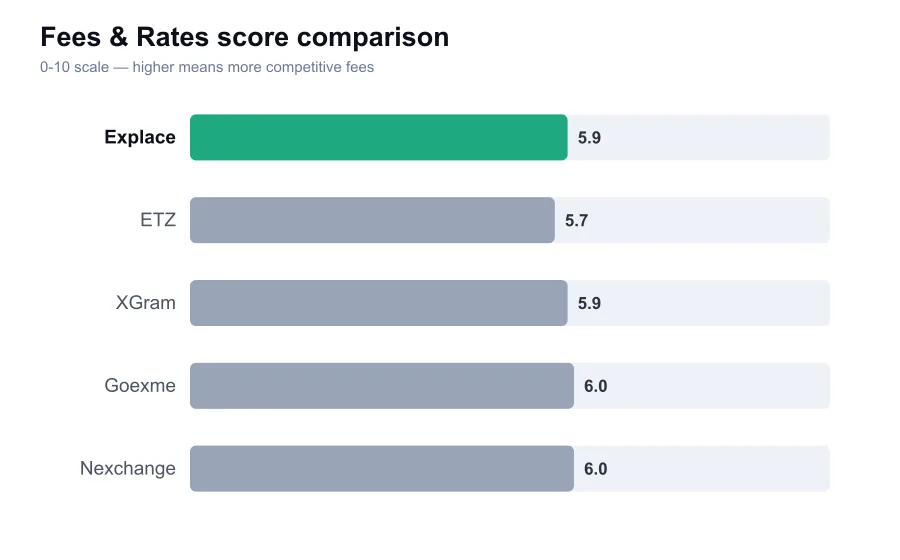
The critical issue is pricing. Explace, like many smaller instant conversion brands, relies on an all-in quote rather than a simple posted taker fee. The displayed payout may include provider spread, market movement, liquidity cost, and blockchain withdrawal cost. Users cannot judge value from a headline alone.
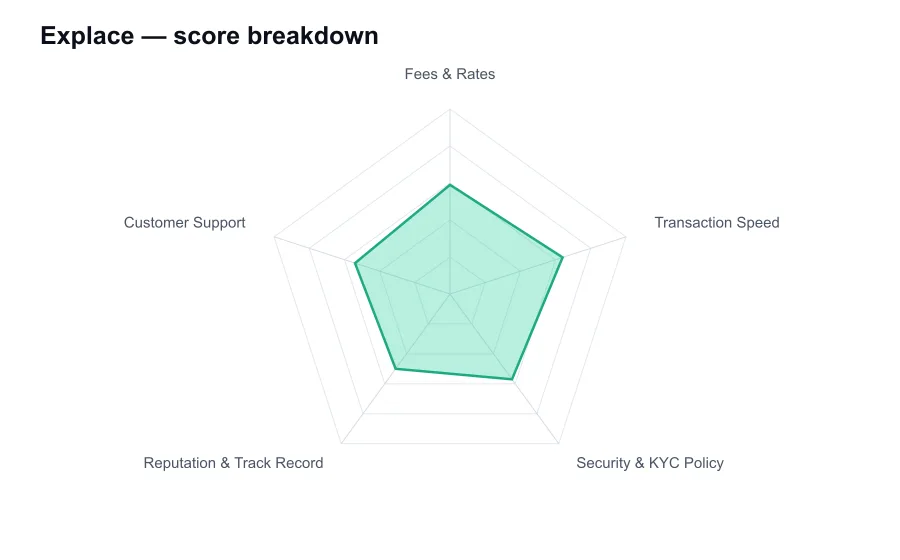
That does not make the service inherently expensive. It does mean that its fee score has to be moderate until it proves competitive on the exact pair a user needs. Compare the final amount, not the percentage label and not a promotional claim about low fees.
For a small swap, a slightly weaker quote may be an acceptable price for speed and simplicity. For a larger transaction, the spread can become material. Traders moving several thousand dollars or more should obtain live quotes from multiple providers and consider whether an order-book exchange provides a better net result.
Transaction speed is generally constrained by the incoming blockchain. Explace can only act after the deposit is detectable and has enough confirmations. Transfers on fast networks may settle quickly, while Bitcoin, Ethereum during heavy traffic, and low-liquidity token routes can require patience.
Users should also understand that an instant exchanger is not a guaranteed-delivery payment service. A malformed address, wrong network, unsupported token contract, or mismatch between sent and expected amount can produce a manual recovery process. That risk is present at every wallet-to-wallet exchanger, but it hits hardest when support and operational history are thin.
Explace has a smaller public profile than the better-known services in this field. It lacks the depth of independently visible operational history that gives users confidence in brands such as Kraken, Coinbase, ChangeNOW, or Exolix. A clean website does not substitute for years of documented handling of difficult customer cases.
I would therefore apply a strict trust limit. Do not treat Explace as a place to park funds, and do not make a first transaction so large that a delay would cause financial harm. Its appropriate role is a limited conversion tool, preferably after a successful small test.
Security claims in this category need careful reading. A non-custodial flow is preferable to leaving a balance on an exchange, because the user controls the destination wallet. But the provider still receives the deposited assets before it completes the conversion, so counterparty and compliance risks are real.
KYC can also be more conditional than customers expect. Even a provider that permits a swap to start without an account can screen transactions and request identification if its risk systems demand it. Anyone who needs certainty around documentation requirements should use a platform with published onboarding terms and complete verification before funding.
Support quality is difficult to grade highly without a broad and easily verifiable public record. Prompt responses are important, but recovery work is the serious test. Before using Explace, check that its support route is available, save its terms and the quote, and retain every transaction detail.
Explace may still be useful for users who understand these limits and have found an attractive route. The product is simple, and simple products can be good. Yet the service has not earned the confidence reserve that lets a reviewer recommend it freely for high-value or high-pressure transactions.
My opinion is that Explace should remain a secondary option rather than a default provider. It can make sense for a small, carefully checked conversion when its live quote is good. For meaningful capital, established providers with longer records, clearer disclosures, and deeper customer-service evidence are a more prudent choice.