Swapter is a smaller instant crypto exchange service focused on direct asset conversions rather than conventional exchange accounts. Its basic role is familiar: it presents a swap quote, generates a deposit address, and pays the requested cryptocurrency to the user's wallet after processing. The category is crowded, and Swapter does not have the name recognition of SimpleSwap or StealthEX. That makes due diligence more important, not less.
The service is aimed at users who want to avoid the friction of creating a full centralized exchange profile for a single conversion. There is no need for order-book expertise, and the flow is easy to understand. Choose the pair, enter a receiving address, send the deposit, then wait for the output. For a person who already knows self-custody basics, that can be a useful shortcut.
Swapter's simplicity is also its limitation. It is not a platform for advanced spot trading, margin positions, recurring purchases, or detailed execution analytics. You are accepting a brokered quote rather than controlling an order on a public market. That can be perfectly reasonable for an occasional conversion, but it is not the same thing as getting the best executable price across an exchange order book.
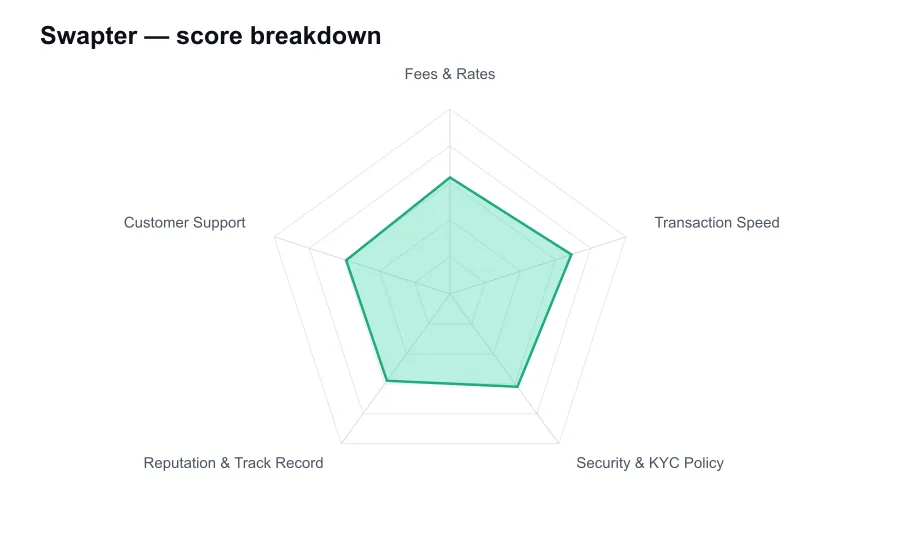
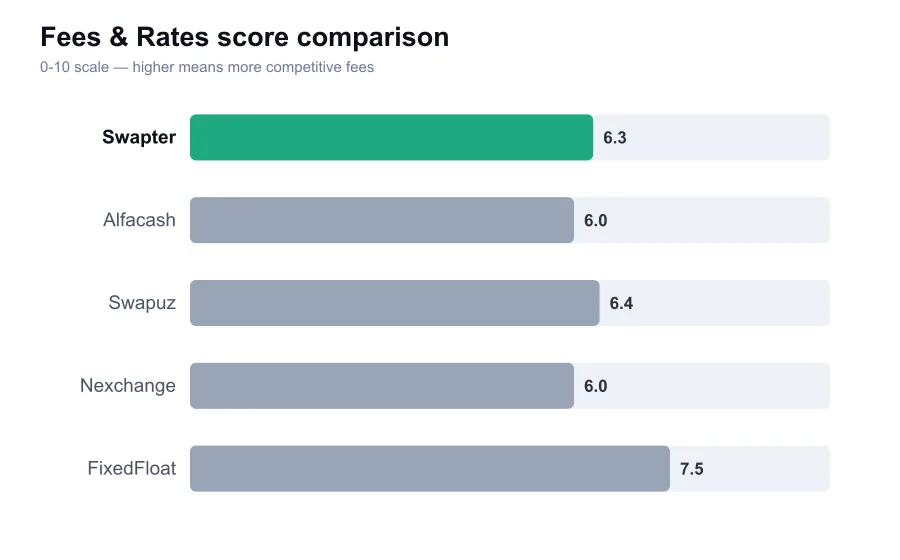
Pricing is quote-based. Swapter does not offer the kind of single maker and taker fee table that lets a trader calculate costs in advance for every pair. The offered output reflects available liquidity, the provider's spread, and relevant network costs. The only honest way to assess the price is to look at the exact receive amount and compare it with another instant exchange or a liquid centralized exchange at the same time.
That approach matters most on large transactions. A small difference in the rate may be irrelevant for a modest wallet rebalance, but it becomes significant when the amount grows. Swapter can make sense where its quote is competitive and convenience is valuable. It should not be selected on brand name alone, because a smaller provider may have fewer liquidity routes or less favorable execution on a particular pair.
Speed should be judged in the same practical way. A straightforward swap can move quickly once the incoming transaction receives its required confirmations, often in the general range of minutes rather than days. Yet actual timing depends on the asset sent, blockchain congestion, the transaction fee chosen by the sender, and liquidity for the requested payout. Bitcoin and some cross-chain routes naturally take longer than a simple transfer on a fast network.
A customer should never interpret the word instant as a promise of immediate finality. Swapter needs to detect and confirm the incoming coins before it can safely process them. If the deposit is underpaid, delayed, or sent on the wrong network, the automated path may stop. That is not merely a customer-service inconvenience. On crypto networks, a technical mistake can be expensive or impossible to reverse.
The non-custodial model is the principal reason to use a service like Swapter at all. Users do not have to park assets in a long-lived exchange balance before initiating a conversion. The intended result goes directly to the wallet address entered in the order. That reduces exposure to exchange-account hacks and withdrawal freezes affecting funds held for weeks or months.
Still, non-custodial does not mean non-trusting. During the swap, Swapter is an intermediary handling a transaction process and relying on liquidity arrangements. The user must trust it to honor the quote terms, identify the deposit, and send the payout correctly. Smaller providers deserve a higher degree of transaction caution because there is usually less independently verified public information about their operations than there is for market leaders.
Its KYC position should be approached realistically. Swapter may allow ordinary exchange requests without a routine sign-up process, but crypto exchange services can apply AML screening and request information where they consider it necessary. Users should read the terms before sending, especially if the funds originate from sources that could trigger blockchain-monitoring flags. A transaction hold after deposit is one of the most frustrating risks in this sector.
Swapter's public track record is less developed than that of the three more established brands in this comparison. That does not establish wrongdoing, and newer or smaller services can process normal orders successfully. It does mean there is less evidence to lean on when assessing resilience, support quality during disputes, and consistency over multiple market cycles. I would not make Swapter my first choice for a large transfer simply because of this information gap.
Support appears centered on online channels rather than a large public-facing service operation. For a routine delayed order, the useful information is the order identifier, deposit transaction hash, asset, amount, network, and payout address. A well-run support team should be able to work from those details. The problem is that smaller services have less margin for error if a case requires manual investigation or an unusual recovery process.
Swapter is therefore a service I would treat as a quote-shopping option rather than a default destination. If it offers a clearly better payout for a standard, liquid pair, a small or moderate swap can be reasonable after verifying the site and network details. If the quote is only marginally better, the larger reputation and support footprint of an established rival may be worth more than the difference.
My verdict is cautious rather than hostile. Swapter has the convenience expected from an instant exchanger and its non-custodial flow is useful for wallet-to-wallet conversions. The concerns are not necessarily a specific operational failure, but the thinner public track record and the same opaque quote structure shared by much of this market. Use a test transaction, preserve every order record, and avoid treating a smaller exchange intermediary as the place for an all-or-nothing transfer.