Swapuz is a non-custodial instant exchange service aimed at people who want to swap crypto without opening a conventional exchange account. It sits in the same broad category as ChangeNOW, SimpleSwap, StealthEX, and LetsExchange. You choose an asset, enter a destination wallet address, send funds to a generated deposit address, and receive the converted asset after the order is processed. That convenience is real, though the service is better understood as a routing layer than as a traditional exchange with its own visible order book.
The first thing to understand is that Swapuz generally does not take custody in the way a centralized exchange does. It processes a conversion through liquidity partners and sends the resulting asset to the wallet address supplied by the customer. That reduces the familiar exchange risk of leaving a balance sitting on a platform for months. It does not remove risk entirely. During the swap, the service and its partners still control the route, the deposit address, and the conversion process.
The interface is clean and easy to grasp. You select the coins, choose a floating or fixed-rate quote where available, enter the recipient address, and confirm the exchange. For a one-off swap, that is a much lighter process than funding an account on Binance or Coinbase, completing identity checks, trading through an order book, and then withdrawing. Experienced users will appreciate the lack of account clutter. New users should slow down before confirming because a wrong network or recipient address can be irreversible.
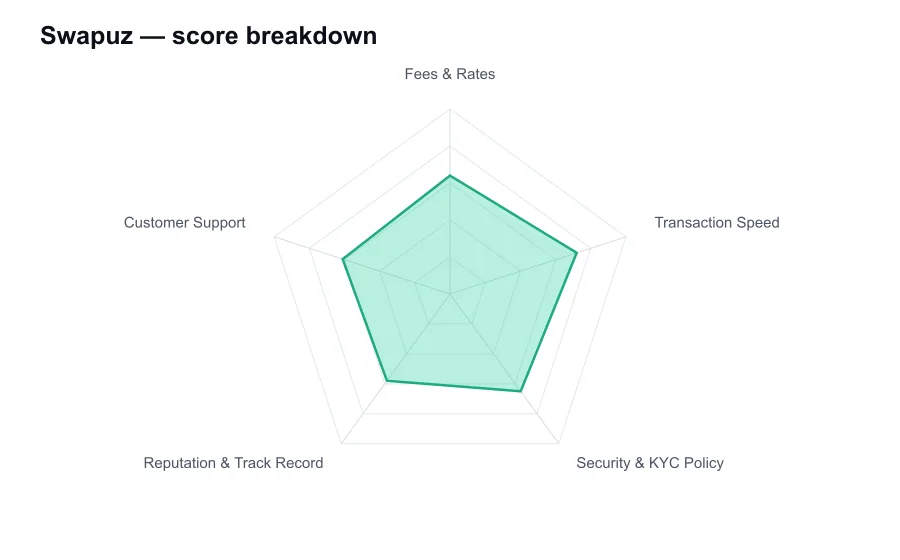
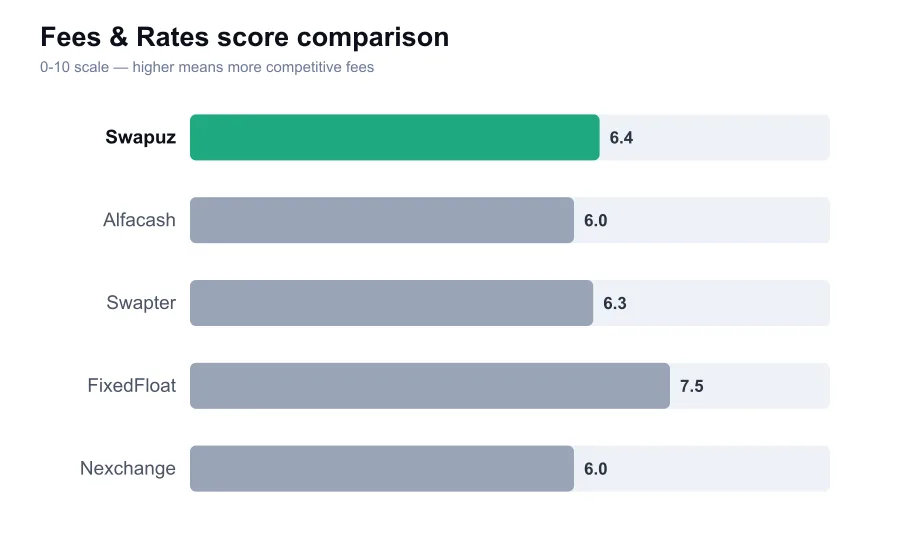
Fees are Swapuz's less transparent area. The company does not present one universal public percentage that applies to every route. The final quote includes the liquidity cost, the spread, network fees, and any service margin that applies to the selected pair. That is common among instant exchangers, but it means marketing language around low fees should be treated cautiously. Compare the exact amount you will receive against at least one competitor before sending funds, especially on large orders.
For small, ordinary swaps, Swapuz can price competitively. The issue is that the quote can be harder to audit than a spot order on a major centralized exchange. A trader using Kraken or Binance can see maker and taker fees, the order-book price, and the withdrawal fee separately. On Swapuz, the important number is simply the amount delivered to your wallet. If that amount is good, the hidden composition of the quote matters less. If it is not, a polished interface does not make it a good trade.
Floating-rate orders carry obvious market risk. The amount shown when you create the order can change before your deposit receives enough blockchain confirmations and reaches the liquidity provider. That is especially relevant with volatile coins, congested networks, or a slow wallet broadcaster. Fixed-rate orders are more useful for users who need to receive a specific amount, though a fixed quote normally has a short payment window and may include a wider spread. Read the expiration information closely rather than assuming the displayed rate is guaranteed indefinitely.
Speed is normally decent for liquid pairs on fast networks. A Bitcoin deposit still depends on confirmation time, while Ethereum and similar networks may be delayed by congestion or inadequate gas settings. Once the deposit is confirmed, a straightforward swap can often complete within minutes. The word straightforward matters. A conversion involving a thinly traded token, a token migration, an unusual network, or a compliance review can take much longer than the front page suggests.
Swapuz is therefore best used for routine conversions such as BTC to USDT, ETH to BTC, or stablecoin swaps on a supported network. It is a weaker choice for time-sensitive arbitrage, a liquidation deadline, or an urgent merchant payment. You do not control the execution venue, and you cannot place a limit order. A centralized exchange with deep liquidity remains the better tool for anyone who needs predictable execution rather than convenience.
Its privacy positioning also needs a realistic reading. Swapuz can be used without creating a standard trading account for many transactions, and that is a genuine advantage for people who dislike unnecessary registration. It should not be read as a promise that every order is anonymous or exempt from compliance screening. Instant exchanges commonly reserve the right to request identification or source-of-funds information when automated risk systems flag a transaction.
That conditional KYC model is the main security tradeoff. It is less intrusive than mandatory onboarding at a centralized exchange, yet users whose funds are flagged can find themselves waiting for documentation review. No-KYC does not mean no AML policy. Anyone exchanging coins associated with gambling services, sanctioned activity, mixers, stolen funds, or other high-risk patterns should assume there is a possibility of a hold. Sending such funds through any instant exchanger is a poor way to solve a compliance problem.
Swapuz publishes basic operational information and uses standard encrypted web connections, but it does not have the multi-year public track record of the oldest brands in this segment. That matters. An instant exchanger can work flawlessly for thousands of normal orders and still be difficult to assess during an exceptional dispute. The important questions are how it handles a delayed partner, a failed payout, or a flagged deposit. Smaller services have less public evidence available on those tests.
The service has built a recognizable presence among no-account swap users, but its reputation remains more limited than ChangeNOW's or Changelly's. That does not make Swapuz unsafe by default. It does mean I would not make it my first destination for a life-changing transaction. Test it with a modest amount, preserve the order ID and transaction hashes, and judge the execution yourself before trusting it with a larger conversion.
Customer support is available through the site's support channels and is most useful if you provide an order ID, deposit hash, chosen pair, and receiving address immediately. Support agents cannot undo a completed blockchain transfer to a wrong wallet. They can, however, trace a delayed order or identify whether a deposit has reached the required confirmation threshold. The quality of support tends to be most visible in abnormal cases, and that is where a smaller provider has less independently documented history.
One practical point is network selection. Stablecoins with the same ticker can exist on Ethereum, Tron, BNB Smart Chain, Polygon, and other chains. Selecting USDT on the wrong network can turn a quick exchange into a recovery request, if recovery is possible at all. The sending network must match the deposit network shown by Swapuz, and the destination wallet must support the network selected for the payout.
Swapuz is useful because it strips a crypto conversion down to a few steps and avoids the friction of a permanent exchange account. Its pricing is acceptable only if you compare the final received amount, not if you assume every instant exchanger has the same spread. I like it for modest, simple swaps where privacy and speed matter more than advanced trading tools. I would use a larger, more transparent venue for big sums, thin assets, or anything with a strict deadline.