Godex is a long-running instant cryptocurrency exchange service built around privacy and straightforward swaps. It does not try to be Binance, Coinbase, or Kraken. There is no conventional trading terminal, no custody account to fund, and no fiat banking layer at the center of the experience. You select a pair, deposit one asset, and receive another to a wallet address you control.
Its most visible selling point is the claim that registration is unnecessary. For a standard exchange, users do not create an account, provide a password, or hand over routine identity documents. That has made Godex popular with users who dislike the data collection common at centralized exchanges. It also means that customers should arrive with basic wallet competence. There is little room for someone who doesn't understand networks, confirmations, destination tags, or private-key custody.
The interface is simple enough that a first swap can be completed in a few minutes. Pick a sending coin and a receiving coin, enter the amount, provide the recipient address, then send funds to the generated deposit address. Godex presents an estimated output, though the precise mechanics depend on the selected asset and current market conditions. It is less intimidating than an exchange order book, which is the point.
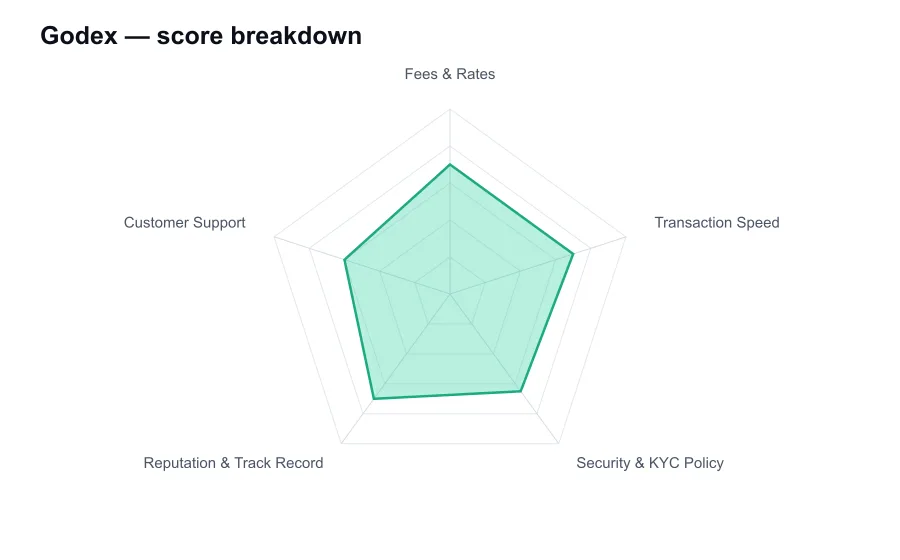
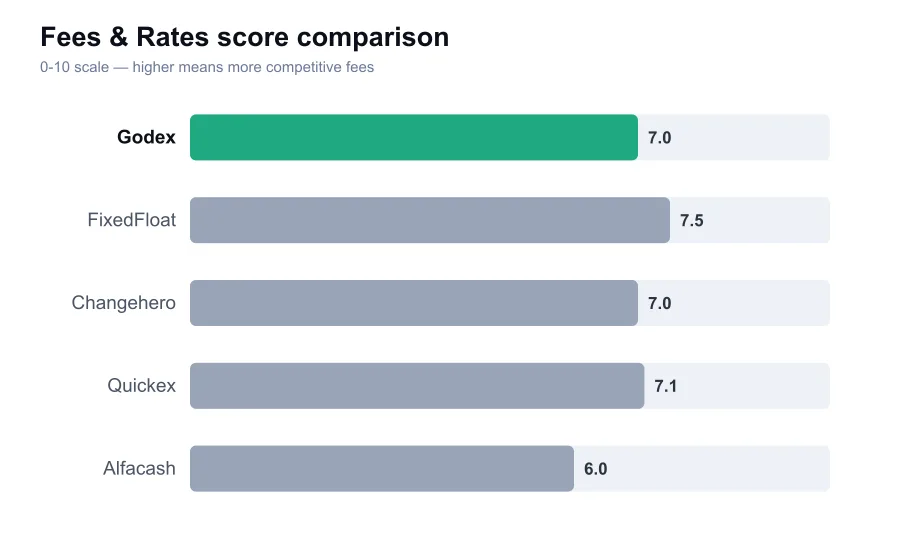
Godex says it charges a 0.5% exchange fee. That is a useful reference point, but it should never be read as the whole price. Instant exchangers route orders through liquidity sources, and the rate shown can reflect spread as well as network costs. On an ordinary BTC to ETH or LTC to BTC swap, Godex may offer a reasonable result. On thin tokens or volatile pairs, the quote can be weaker than a large exchange or another swap provider.
The absence of visible trading fees can make competitors look cheaper than they are, while a visible 0.5% fee can make Godex look expensive. I prefer Godex's relative directness, but users should judge the actual receive amount. Open Godex, LetsExchange, ChangeNOW, and perhaps a centralized exchange quote if you already have an account. The best provider is the one delivering the best verified result for that specific route, not the one with the prettiest fee claim.
Godex normally uses floating-rate execution. That means the quoted amount can move between the time you create the order and the time the deposit gets enough confirmations. This is manageable with fast networks and liquid assets. It is more uncomfortable for Bitcoin during congestion, or during a sharp market move. Users who need a guaranteed output amount should choose a service that explicitly offers a fixed-rate order, or use a conventional limit order on an exchange.
Transaction speed is adequate rather than exceptional. The service can process liquid-chain swaps promptly after it receives the required confirmations, but it has no special advantage that defeats blockchain settlement time. Bitcoin deposits take as long as Bitcoin deposits take. Ethereum gas spikes can delay the outgoing leg. Godex is perfectly usable for routine exchanges, though it is not the provider I would select solely because I need an unusually time-sensitive execution.
Godex's asset selection is broad enough for mainstream users and includes major coins, stablecoins, and many smaller altcoins. Broad selection has a downside. A listed token is not necessarily a deep-liquidity token. Small-cap coins may have larger spreads, limited route availability, or more frequent delays. The right approach is to treat the quote screen as the real availability test rather than assuming every displayed asset is equally practical to exchange.
Security is mostly about the transaction model. Godex does not hold a permanent customer account balance, which limits exposure compared with leaving assets on a custodial exchange. Still, users transfer coins to a Godex-controlled address during the swap. That creates counterparty risk until the payout is complete. Non-custodial is a useful description, but it does not mean trustless, decentralized, or risk-free.
The no-registration policy also has limits. Godex may screen transactions for suspicious activity and may require information if a transfer triggers compliance controls. This is standard across much of the instant-exchange sector, even among providers that advertise no KYC. A user who needs certainty that no documents will ever be requested should not rely on any centralized swap intermediary. The honest expectation is that routine orders may be private, while exceptional orders can become complicated.
Godex has been around long enough to have more market recognition than newer anonymous swap sites. That matters. It has a visible brand, a substantial history of user discussion, and established referral relationships across crypto websites. Still, it is not a regulated household-name exchange with audited public reporting, named executives, and formal customer protections. Its reputation is serviceable, not institution-grade.
Support is available through the website and email channels, and the service has historically promoted 24-hour assistance. Routine questions are generally easy to resolve. The harder cases are delayed orders and deposits with missing tags or wrong-chain transfers. User reports are mixed in the way they are for most instant exchangers: uncomplicated orders often go smoothly, while exceptions can take patience. Don't send an amount that would cause real harm if support takes days rather than minutes.
One practical strength is that Godex does not pressure the customer into a lengthy onboarding process. One practical weakness is that there is no account area with the robust controls, statements, and escalation routes offered by established exchanges. That trade is acceptable for a modest one-off swap. It is much less appealing for a business payment, a six-figure trade, or any transaction that needs accounting certainty.
Godex is best understood as a convenience service for crypto-native users. It is private in the everyday sense, fast enough for normal swaps, and easier to use than moving funds through a full exchange. It is not the cheapest route in every case, and its floating-rate design is not ideal for people who need a locked output. I would use it selectively after comparing live quotes, with a strong preference for small or medium transactions. That is praise with boundaries, which is the right way to approach nearly every instant exchanger.