FixedFloat is one of the better-known non-custodial instant swap services. It sits in the same broad category as ChangeNOW, SimpleSwap, StealthEX, Godex, and LetsExchange, but it has always tried to distinguish itself with a stripped-down interface, Lightning Network support, and a choice between floating and fixed exchange rates. The service is built for people who already hold crypto and want to exchange it without opening a trading account or leaving assets on an exchange.
The user experience is unusually direct. Choose the asset you are sending, choose the asset you want to receive, enter a destination address, and FixedFloat generates a deposit address. There is no portfolio page, no fiat gateway, no order book, and no account requirement for a normal swap. That simplicity is attractive, particularly for experienced users who don't need a platform to explain what Bitcoin or USDT is.
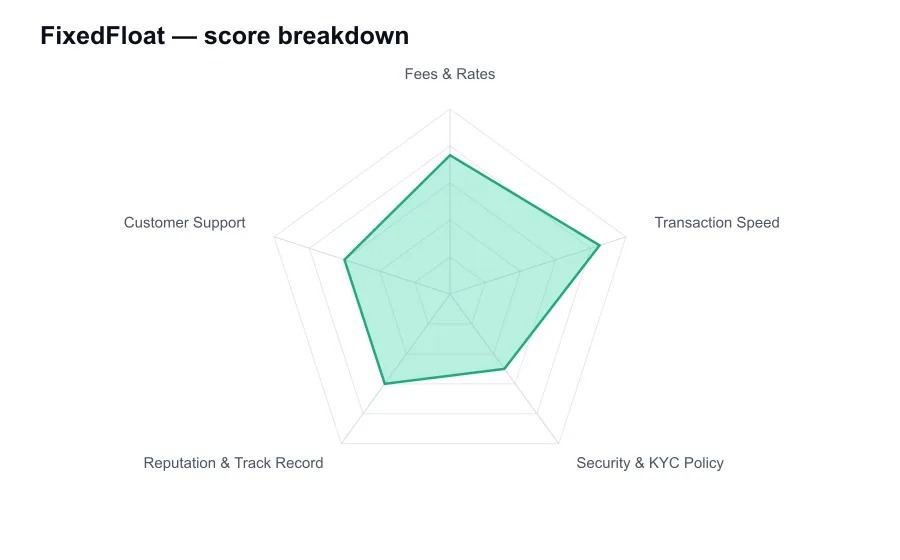
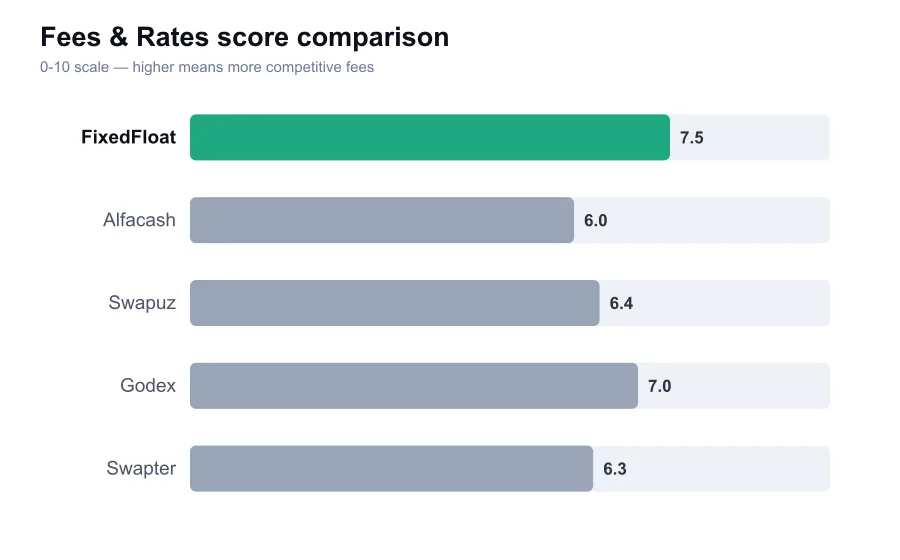
FixedFloat's two-rate system is still its most useful feature. A floating-rate order charges a stated 0.5% service fee, while the final amount can move with the market before the swap completes. A fixed-rate order is quoted with a 1% service fee and is designed to protect the output amount against market movement for a limited period. In a fast market, paying more for certainty can be sensible. In a quiet market, the floating route is usually the cheaper choice.
Those stated fees are only part of the bill. Like every instant exchanger, FixedFloat has to source liquidity and pay network costs. The actual rate can include spread from liquidity partners, and network fees can be substantial on Bitcoin and Ethereum during busy periods. A 0.5% headline fee sounds excellent, but readers should compare the exact receive amount against at least one rival before sending funds. FixedFloat can be competitive, though it is not automatically the best quote on every pair.
The fixed-rate option needs to be understood properly. It is not a promise that the service will absorb every extreme market move indefinitely. You have to send the correct amount to the assigned address within the stated time window. A late payment, an underpayment, or a transaction sent on the wrong network can change the result and create a support case. That's normal for this business model, but it is a poor fit for someone who routinely sends transactions slowly from a platform with delayed withdrawals.
Speed is where FixedFloat has historically been strong. Straightforward swaps between liquid assets can complete soon after the incoming transaction receives enough confirmations. Litecoin, XRP, Tron-based USDT, and Lightning payments can feel almost immediate. Bitcoin and Ethereum swaps naturally take longer because confirmation requirements and chain congestion matter. FixedFloat can't make Bitcoin blocks arrive faster, but its order flow is generally less cumbersome than a conventional exchange withdrawal process.
Its Lightning Network integration is a genuine advantage, not just a marketing badge. Users can exchange into or out of Bitcoin through Lightning invoices, which can reduce wait times and on-chain fees for appropriate transactions. That is particularly useful for people moving modest Bitcoin amounts, merchants settling balances, and users who already manage a Lightning wallet. It does require care, since Lightning invoices expire and invoice amount rules differ from ordinary on-chain addresses.
The security model deserves a mixed assessment. FixedFloat is non-custodial in the limited sense that it does not hold a standing account balance for customers. Funds are sent for a specific swap and then forwarded to the destination address. That reduces the familiar risk of leaving coins parked at a centralized exchange. It does not remove operational risk, because the service still controls funds temporarily while it processes the exchange.
That distinction became painfully important in February 2024, when blockchain analysts linked suspicious outflows of roughly $26 million in Bitcoin and Ethereum to FixedFloat wallets. The service later acknowledged a security incident, saying that its technical structure had been attacked. Whatever the exact attack path was, this was a serious event. A swap service handling user deposits must be judged partly by what happens when systems fail, and FixedFloat's history cannot be described as spotless after that incident.
The platform generally markets itself as registration-free and does not require routine KYC for ordinary swaps. That is useful for privacy-minded users, but it should not be mistaken for an unconditional guarantee. Anti-money-laundering screening can lead to a transaction being flagged, paused, or referred for additional verification. The practical issue is not whether a site calls itself anonymous. It is whether its terms make clear what happens if funds are held. FixedFloat's limited public-company transparency makes that harder to assess than it should be.
Reputation is therefore split. The service has been operating for years, it is widely recognized among instant-exchange users, and its Lightning support has earned it a loyal following. Yet the 2024 exploit materially weakens the trust case. Users should not treat a familiar name, or a long list of supported assets, as proof that a provider is safe for a large transfer. FixedFloat is better viewed as a transaction tool, not a place to concentrate funds.
Customer support is available through its website channels, including a live-chat style interface and email contact. Reports from ordinary successful swaps are usually uneventful because there is little reason to contact support. The real test is an exception: a delayed payout, wrong memo, compliance review, or partial deposit. In those situations, the lack of a transparent corporate profile and a robust public escalation process is frustrating. Support may resolve a case, but customers have limited leverage if it doesn't.
There are also practical asset-specific traps. XRP requires the correct destination tag where one is provided. Stellar and some Cosmos-family assets may require memos. USDT exists on several incompatible networks, and choosing the wrong one can turn a cheap swap into a recovery request. FixedFloat shows network information in the order flow, but the user remains responsible for checking it. Don't assume that a token ticker alone identifies the asset.
For small and medium-sized swaps where speed matters, FixedFloat remains a useful service. I like the clear choice between floating and fixed rates, and Lightning support gives it a real edge over many generic swap widgets. I would not use it blindly for a large one-off transfer after the 2024 security incident, especially if the assets are difficult to replace. Split a large transaction, verify the payout address, and test the route first. FixedFloat is capable and convenient, but it is no longer a provider that deserves automatic trust.