Quickex is a non-custodial instant exchange service aimed at people who want to swap crypto without opening a conventional trading account. It sits in the same broad category as ChangeNOW, SimpleSwap, StealthEX, and SwapSpace, acting as an intermediary that sources liquidity and sends the output asset to a wallet address chosen by the customer. It is built for a quick conversion, not for active trading, charting, or holding a portfolio on-platform.
The appeal is obvious. There is no order book to understand, no account balance sitting on the service, and usually no standard registration step before a modest swap. You choose the asset you are sending, the asset you want, enter a destination address, and receive a deposit address. That is a much cleaner experience than using a centralized exchange for someone who simply needs to convert BTC into USDT or exchange ETH for another asset.
Quickex offers both floating-rate and fixed-rate exchanges. The floating option is generally the better quoted price, but the final amount can move with the market while the exchange is processed. Fixed-rate swaps protect the quoted output for a limited payment window, though the quoted rate is usually less attractive because the provider is taking market-risk protection into account. That structure is standard for this kind of service, but users should understand it before assuming a displayed amount is guaranteed.
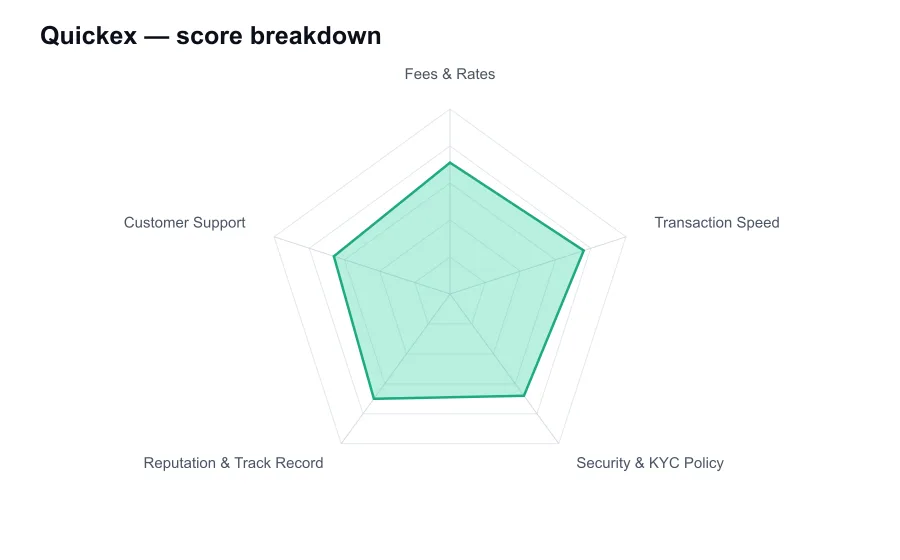
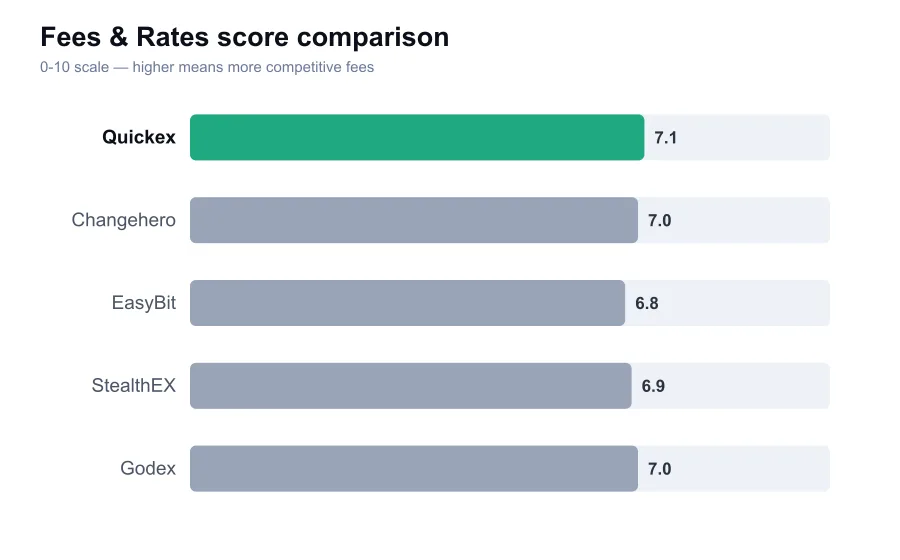
Fees are not presented as one easy universal percentage. The rate shown to the customer generally includes Quickex's service margin, network costs, and liquidity-provider pricing. That is common among instant exchangers, although it makes direct fee comparisons difficult. A swap can look cheap in percentage terms yet still be poor value because of a wide spread between the market price and the offered rate. Check the receive amount against at least one competitor before sending, especially on larger transactions.
For small and mid-sized swaps, Quickex can be competitively priced, particularly on liquid pairs such as BTC, ETH, LTC, USDT, and USDC. The service becomes less compelling on thinly traded assets, obscure token networks, or periods of violent price movement. In those cases, the liquidity route matters far more than a headline claim about low fees. A transparent breakdown would improve the product, but the final quoted output is still the number that matters.
Speed is good when the route is straightforward and the incoming transaction confirms promptly. Many normal swaps finish in roughly 10 to 30 minutes after the deposit is confirmed, while Bitcoin transactions can take longer simply because the chain itself is slower. Fixed-rate orders also need to be funded before their payment deadline. Users who send from a wallet with a very low miner fee can turn a quick swap into a long wait.
The service is less predictable with assets that need several confirmations, congested networks, or transactions that require manual review. That is not unique to Quickex, but it is where instant-exchange marketing can become misleading. A swap isn't truly instant if the blockchain takes an hour to confirm the incoming deposit. The practical expectation should be prompt processing after confirmations, rather than immediate settlement from the moment you click exchange.
Quickex is non-custodial in the limited but important sense that it does not operate as a long-term account custodian for normal users. Your coins are sent into a transaction flow, then the resulting asset is sent to your nominated wallet. That reduces exposure to the familiar risk of leaving funds parked on a centralized exchange. It does not mean the swap is trustless. You still trust Quickex and its liquidity partners to complete the conversion correctly.
Its KYC position should be read carefully. Quickex markets a registration-light process, but it retains the ability to request identity checks under anti-money-laundering procedures or where a transaction triggers risk controls. That is normal in this sector, and anyone claiming that every swap is guaranteed anonymous is overselling it. If Quickex requests documents after funds arrive, the user may face a hold while compliance staff assess the transaction.
This is the main security tradeoff. There is less routine data collection than at a large regulated exchange, but there is also less formal recourse if a swap is delayed, a destination address is entered incorrectly, or a compliance check is triggered. There are no account-level controls such as withdrawal allowlists that a customer can configure. The most important security practice is still local, verify the coin, network, amount, and destination address before payment.
Quickex has been operating since 2018, which gives it more history than a newly launched exchange widget. Its public reputation is decent rather than exceptional. It has attracted positive feedback from users who value simple swaps and no mandatory account creation, but there are also the familiar complaints seen across instant exchangers: rate changes on floating orders, delayed transactions, and frustration when a transaction is subject to verification.
That mixed record doesn't make Quickex an obvious scam, but it does mean it should not be treated like a regulated broker with a dedicated account manager. The service is best judged by its operational behavior on ordinary swaps, its published terms, and how it handles a support case. For a large one-off conversion, splitting the transaction or completing a small test swap first is sensible, particularly if the receiving wallet is new.
Support is available through the site's live chat and email channels, and the practical quality is usually strongest for simple order-status questions. Providing an order ID, transaction hash, sent amount, and destination address gives the team something actionable. Broad complaints without transaction details tend to go nowhere, just as they do with competitors. There is no reason to expect the depth of support offered by a major exchange with phone operations and formal escalation teams.
Quickex works well as a utility, not as a crypto home base. It is a credible choice for a user who understands wallet transfers, wants a straightforward non-custodial conversion, and compares quotes before sending. It is a weaker choice for people who need audited fee schedules, guaranteed fiat access, advanced trading tools, or certainty that KYC can never arise. My view is that Quickex is useful, but it deserves the same caution you would apply to any brokered instant swap service.