Trocador is an exchange aggregator, not a conventional crypto exchange. That distinction is central to judging it fairly. Rather than presenting its own trading book, Trocador compares offers from a range of instant exchange partners and lets the customer select a route. It has become particularly familiar to privacy-minded Bitcoin users because it combines a no-account workflow with a strong preference for self-custody and a visible attempt to show which providers may demand verification.
The service was founded in 2019 and has outlasted plenty of short-lived no-KYC exchange sites. That does not put it in the same trust category as a major regulated exchange with audited reserves and a large compliance department. It does give Trocador a meaningful operating history in a difficult niche. In crypto, surviving several market cycles without turning into a dead domain or an obvious exit scam counts for something.
Trocador's basic proposition is sensible. Enter the amount and pair you want, compare available partner offers, then choose one based on payout, estimated speed, and KYC status. The company acts as an intermediary and, depending on the selected route, may pass the order to a partner exchanger for execution. That design gives users more choice than a single instant exchanger. It also means the experience is only as good as the underlying partner selected for a particular order.
The comparison screen is Trocador's strongest feature. A good aggregator should not tell customers that one route is universally best. It should show alternatives so users can decide whether they value payout, speed, or a route that is less likely to impose KYC. Trocador does this better than many slicker-looking competitors. It is especially useful when swapping Bitcoin into a stablecoin or another major asset, where several providers may quote materially different payout amounts.
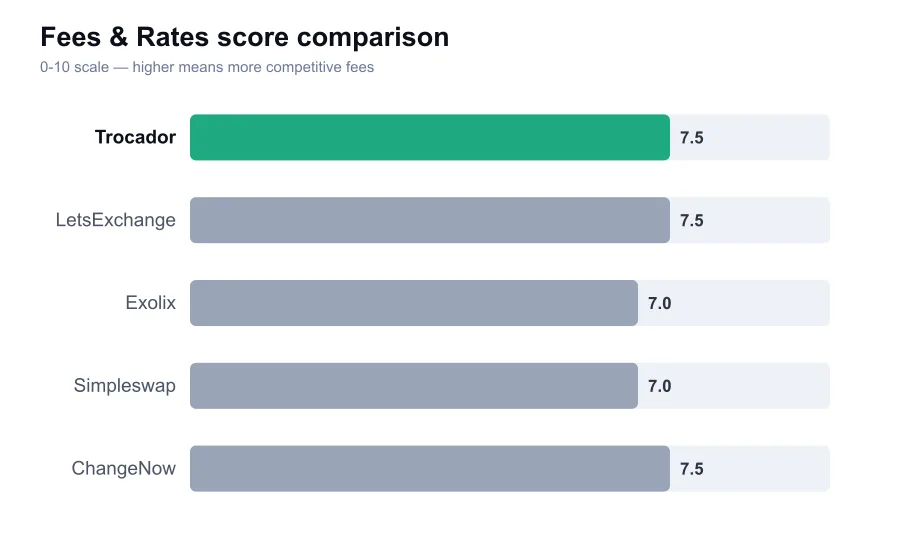
Fees are more understandable here than at many instant exchange sites. Trocador states that it adds a service fee of up to 0.5 percent to exchanges, while partner pricing, spreads, and network costs still affect the final quote. The phrase up to matters. The effective cost can vary by provider and pair, so the correct comparison remains the final amount received. Still, a stated ceiling is more honest than pretending that a quote with an embedded spread is fee-free.
The platform has also offered affiliate and promotional mechanisms that can reduce its own fee in some cases. Users should not let a coupon decide where they swap. A reduced aggregator fee can be wiped out by a weaker partner quote or a higher blockchain fee. For modest Bitcoin swaps, the difference between routes can be meaningful. For cheap networks and low-value swaps, network fees and minimums can dominate the economics.
Trocador Protect is the feature that separates it from a bare comparison site. For an additional fee, it is intended to provide support and compensation protection if a selected exchange partner fails to complete an order under the program's terms. I like the idea because instant-exchange failures are usually miserable for users. A route may involve a third party, an unfamiliar support desk, and a deposit already sent on-chain. Protection is not insurance in the regulated financial sense, and customers should read the applicable conditions, but it is a serious attempt to address a genuine pain point.
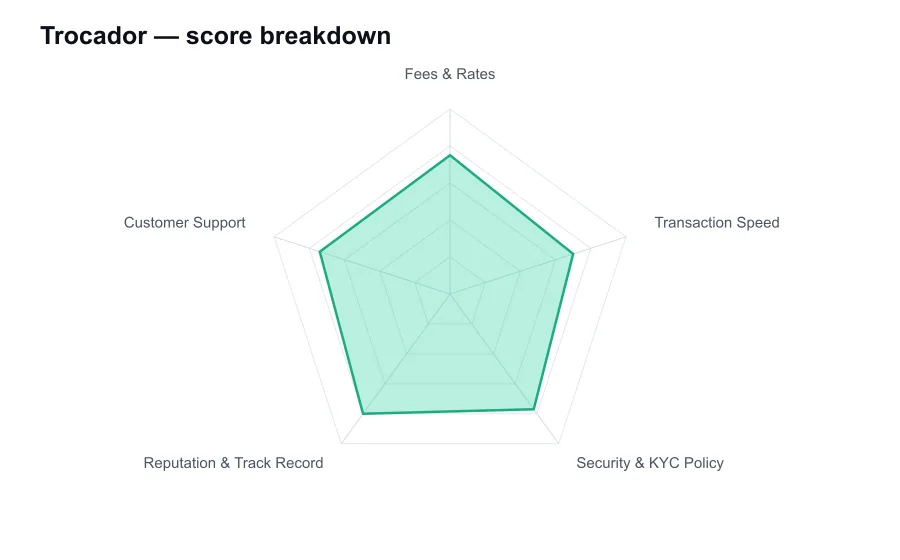
Speed depends almost entirely on the partner and the chain. Trocador can show estimated processing times, which helps, but it cannot make Bitcoin confirmations arrive faster or force a liquidity provider to release a payout during a manual review. Common coin pairs through established partners are often completed after the deposit confirms. Privacy-oriented routes, thin assets, unusually large orders, and transactions that trigger screening can take much longer. The aggregator is transparent about routes, but it does not control every operational delay.
The KYC filter is valuable, although it is often misunderstood. A route described as no-KYC means the partner does not ordinarily require identity verification at the outset. It does not mean an exchange partner can never pause a transaction for risk review. Trocador itself has long warned users that partners can impose KYC when their policies or automated controls require it. Anyone claiming that crypto swaps provide guaranteed anonymity is selling fantasy.
This is where Trocador's reputation is stronger than its raw size might suggest. It has cultivated a privacy-first user base and has earned attention from people who care about censorship resistance, self-custody, and transparent routing. Its public identity is more distinct than a generic instant exchange site. There have also been the usual complaints seen across the sector, particularly around partner delays, verification requests, and orders affected by blockchain conditions. Those complaints should not be dismissed, but they are not evidence that every disputed transaction is caused by Trocador itself.
Security is helped by the absence of a conventional custodial balance. You are not asked to leave funds on the service and hope it remains solvent. Yet there is an unavoidable custody moment once you send the deposit to the route's address. The best defense is operational discipline: use your own wallet, inspect the selected provider, make sure the network matches, and retain records. Trocador cannot rescue a deposit sent from the wrong chain merely because it was initiated through its interface.
Support is one of Trocador's better areas for this type of business, especially for users who choose Trocador Protect. The team can act as an escalation point between the customer and a partner exchange, which is more useful than being left to chase an unknown provider alone. That said, support cannot override blockchain finality or instantly resolve a compliance hold at a third party. Be wary of any review claiming that an aggregator can guarantee immediate recovery in every case.
Trocador makes more sense for users who understand why they are avoiding a centralized exchange. It is excellent for comparing wallet-to-wallet conversion routes, and the no-KYC labeling is genuinely helpful. It is not designed for charting, perpetual futures, fiat deposits, recurring buys, or professional execution. If you want to trade frequently, pay low disclosed maker fees, and rely on deep liquidity, use Kraken, Coinbase Advanced, or Binance where legally available.
The service also rewards skepticism. Do not sort exclusively by the highest payout if the provider is unfamiliar, the estimated processing time looks unrealistic, or the route requires a token network you have not used before. A slightly worse quote from an established partner can be the sensible choice. For a large exchange, splitting funds into test-sized transactions may be wiser than treating the first route as a blind leap of faith.
My view is that Trocador is one of the more credible services in the privacy-conscious instant-exchange corner of crypto. Its 0.5 percent stated service-fee ceiling, route comparison, and optional protection mechanism give it more substance than a simple anonymous swap widget. The price of that flexibility is complexity and partner dependence. Use it as a smart routing tool, choose partners carefully, and do not confuse a no-account purchase flow with a guarantee that compliance checks will never happen.