StealthEX is an instant crypto exchange service that leans heavily into privacy-friendly, registration-light swaps. It belongs to the same brokered exchange category as Quickex and SimpleSwap, but it has made a stronger public identity around avoiding routine account creation. The basic idea is simple: select a pair, send the deposit, and receive the converted asset in a self-custody wallet. It is practical for conversions, not for day trading or long-term custody.
The name can create unrealistic expectations. StealthEX does not require a standard account for ordinary swaps, but that does not mean every transaction is permanently beyond compliance review. Like other centralized exchange intermediaries, it can use anti-money-laundering screening and can request documents or information where its policies require it. People choosing it solely because they assume verification is impossible are likely to be disappointed.
Where StealthEX does stand out is the breadth of its swap-oriented offering. It supports a large selection of cryptocurrencies and networks through liquidity partners, and it has integrated practical tools such as an exchange widget and API for third parties. That broad coverage is convenient, especially for users moving between major coins and newer network tokens. It also raises the usual risk of selecting the wrong token contract or chain variant.
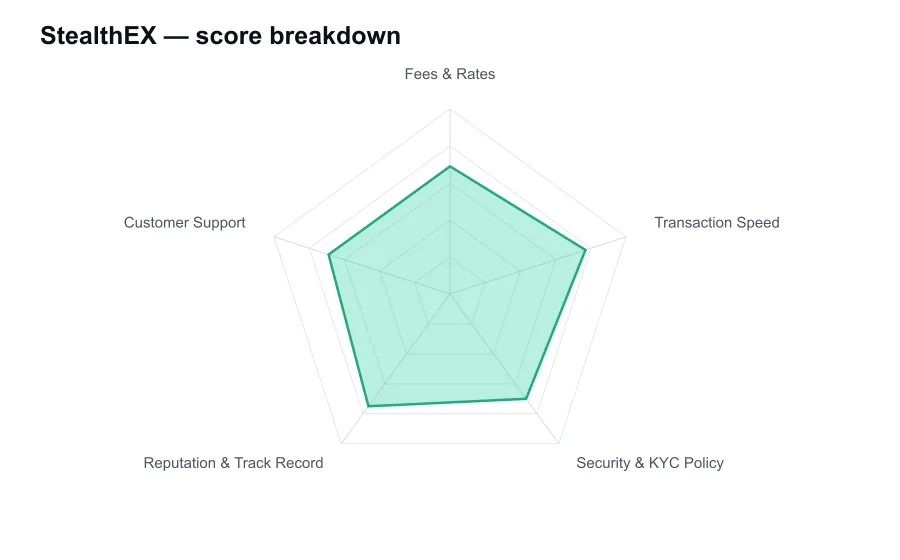
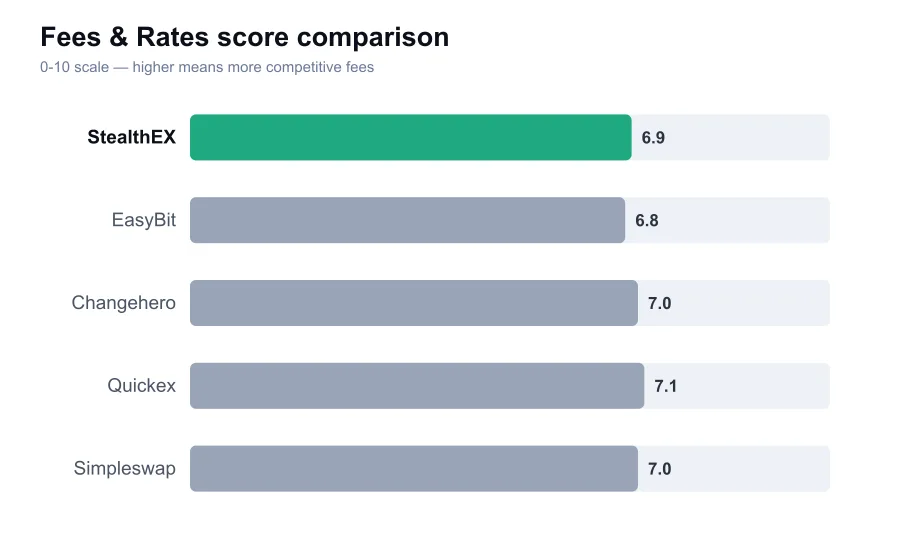
Its pricing is quote-based rather than built around one flat published service fee. The exchange result presented before a transaction includes market liquidity, the service's margin, and blockchain network costs. Fixed-rate swaps normally build in more protection and can have a less favorable rate than floating orders. This is a reasonable commercial structure, but it demands that the user compare actual outputs instead of treating a marketing page as proof of low cost.
StealthEX can be attractive on liquid pairs, but it isn't reliably the cheapest source for every trade. The difference can be meaningful on Ethereum tokens, cross-chain stablecoin transfers, and lower-volume assets. A user making a $100 swap may sensibly pay a little extra for convenience. Someone converting $10,000 should care about the spread, the network fee, and whether a centralized exchange's order book would produce a better result.
Speed depends heavily on the source and destination networks. A normal swap involving readily available liquidity can be processed soon after the deposit is confirmed, often within 10 to 30 minutes. Bitcoin, congested Ethereum transactions, and assets requiring more confirmations can take longer. The service can only exchange what it can safely recognize, so a low-fee deposit that remains unconfirmed is a user-side delay, not proof of a failed order.
StealthEX's fixed-rate function is useful for people worried about fast market moves. It gives a set exchange amount subject to the order's stated terms and payment deadline. The detail that matters is exactness. Send a different amount, use the wrong network, or pay after the allowed period, and the order may need manual handling or be recalculated. That is why a fixed quote should be used deliberately, not casually.
The non-custodial label is broadly appropriate for its ordinary workflow. StealthEX does not ask you to preload a permanent platform wallet and trade inside a balance sheet account. Funds pass through the exchange route and are paid out to the receiving address. Yet the transaction is still mediated by StealthEX and liquidity providers, so the security model is based on operational trust, not smart-contract self-execution.
There is a practical security benefit to avoiding a long-term exchange balance. A platform breach cannot expose coins you never leave there after the swap completes. The risks move elsewhere: phishing copies of the site, clipboard malware that replaces addresses, incorrect network selection, and an unexpected AML hold. The first two are especially dangerous because a completed blockchain transfer is generally irreversible.
StealthEX has operated since 2018 and is well known among instant-exchange users. It has built a more visible brand than many small swap sites, and its third-party integrations suggest it is not a temporary storefront. Still, a long operating history does not turn it into a regulated bank or make all user complaints irrelevant. Its public record includes the same types of grievances found throughout this business model, particularly delays, changed floating rates, and verification disputes.
I rate its reputation as respectable for an instant exchanger, though not in the same risk category as a major licensed exchange with public financial reporting. The company has enough history to pass a basic credibility test. It has not earned a blank cheque. Keep transaction sizes sensible, use a wallet you control, and do not send a deposit until the pair, payout address, and network labels have all been checked.
Support is available through live chat, email, and the site's transaction-status tools. In straightforward cases, support can identify whether a deposit is waiting for confirmations, being exchanged, or already paid out. In complex cases involving compliance review or technical recovery, resolution can take longer and may depend on information the user cannot provide instantly. That is frustrating, but it is a reality of centralized intermediaries handling blockchain transfers.
StealthEX is strongest for experienced self-custody users who want a wide range of crypto swaps without the ceremony of a centralized exchange account. It is less appropriate for beginners who have never handled network selection, or for privacy absolutists who cannot tolerate a possible document request. The service is useful, but it rewards careful users and punishes rushed ones.
My final view is favorable with conditions. StealthEX has a mature instant-exchange product, broad coin coverage, and a sensible non-custodial flow. Its quote-based fees and possible compliance interventions are real limitations, not footnotes. Compare its output, send a test amount for unfamiliar routes, and keep records of the order. Used that way, it is one of the more credible tools in its category.