SimpleSwap is one of the better-known names in the instant-exchange category. Founded in 2018, it offers a polished crypto conversion interface without requiring users to run an order book or keep a trading balance at the company. It is built around a simple promise: send one cryptoasset, receive another in your own wallet. That makes it accessible, though it should not be confused with a decentralized exchange or a full-service trading venue.
The product has matured beyond a bare exchange form. SimpleSwap supports floating and fixed-rate transactions, has a loyalty-oriented SimpleSwap Coin program, and offers an affiliate API and widget for partners. For the ordinary user, none of that matters as much as the basic execution quality. The key question is whether the quoted rate is competitive, the payout lands on the right network, and a support agent responds when an order gets stuck.
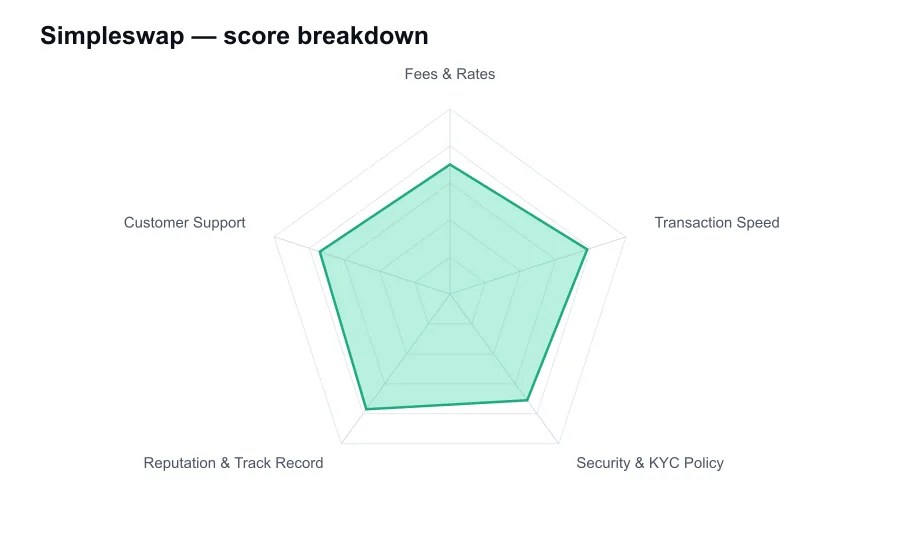
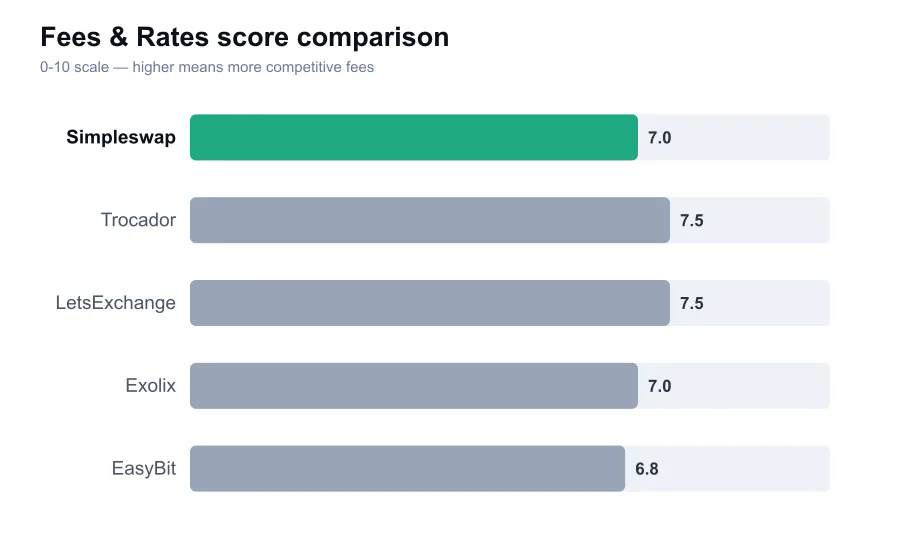
Its fee presentation follows the usual instant-exchange model. There is not a single public percentage that can be applied to every asset pair. Instead, SimpleSwap calculates a quoted receive amount using its liquidity sources, service margin, network fees, and market conditions. The effective cost is therefore best measured by comparing the amount you receive against a reputable exchange or two at the same moment.
That lack of a flat fee schedule is a drawback for sophisticated users. It makes SimpleSwap less transparent than an exchange that charges, for example, a stated maker and taker fee. Still, the service is often reasonably competitive for convenience swaps on major assets. The fixed-rate route normally costs more than the floating route, which is logical because SimpleSwap takes on price risk while your deposit is traveling through the blockchain.
Do not assume the lowest displayed rate means the cheapest trade. Network costs can dominate small Ethereum or Bitcoin transactions, and a low-liquidity token can carry a substantial spread. SimpleSwap is generally better for a clean, moderate-sized conversion than for trying to execute a very large position at the best possible price. Anyone swapping a five-figure amount should obtain competing quotes and consider splitting the order.
Settlement speed is usually solid. Once an incoming transaction has enough confirmations, a liquid swap commonly completes within minutes, while a normal expectation for many pairs is around 10 to 30 minutes. The variable is often the sender's blockchain fee, not SimpleSwap's internal workflow. Bitcoin deposits, busy Ethereum periods, and assets with high confirmation requirements can all delay the point where the exchange can begin.
The fixed-rate option is useful but needs discipline. It is not a magic price lock for any amount you happen to send later. The customer must send the exact required amount to the generated address within the payment time shown on the order. An underpayment, late payment, or incorrect network can turn a simple transaction into a manual support case. That is where many negative instant-exchange reviews originate.
SimpleSwap describes itself as non-custodial, and for normal transactions that description is fair. It does not ask customers to maintain a permanent trading balance before swapping. Your funds move through the exchange process and are then paid out to the wallet address you supply. That reduces the danger of leaving a large long-term deposit with an exchange, but it does not remove counterparty risk during the transaction itself.
KYC is not routinely required for every customer at the start of the process. Yet SimpleSwap's terms and compliance procedures allow it to ask for verification in certain cases. This can include transactions flagged by risk systems or requests connected with anti-money-laundering rules. A user who needs a guaranteed no-document experience should not rely on any centralized instant exchange, including this one.
The company has a reasonably visible track record for its category. It has operated since 2018, maintains public product pages and support channels, and has amassed a large number of customer reviews. That is more reassuring than a newly created site with no history. It also has the standard reputation risks of the sector, particularly complaints connected to changing rates, compliance holds, and users sending unsupported networks.
My view is that SimpleSwap's reputation is stronger than many anonymous exchange widgets but weaker than a large regulated platform with audited public disclosures and formal investor protections. That is not a criticism unique to SimpleSwap. It is the natural consequence of being an intermediary that routes crypto swaps while collecting relatively little information at the outset. Treat it as a transaction service, not as a place to store money or resolve complex disputes.
Customer support is one area where SimpleSwap is more credible than many tiny competitors. The site provides live chat, email support, an order-tracking page, and a help center. Response quality can still depend on whether the problem is straightforward. An order delayed by blockchain confirmations is easy to explain. A transaction caught by a compliance provider or sent through the wrong chain is harder and can take longer.
The best way to use support is to arrive prepared. Give the order ID, transaction hash, exact sent amount, selected network, and receiving address. Screenshots help where a wallet interface is involved. Avoid sending repeated transfers to the same deposit address while waiting for an answer. That can complicate reconciliation and is unlikely to make the case move faster.
SimpleSwap is a good consumer-facing instant exchanger, especially for users who prioritize a familiar interface, broad pair selection, and a non-custodial workflow. It is not the best place for price-sensitive traders, people who need ironclad privacy guarantees, or anyone unfamiliar with basic wallet and network mechanics. I would use it for a routine, carefully verified swap after comparing the final quote. I would not use it as a substitute for a proper exchange account or a self-custody plan.