ChangeNOW is one of the best-known names in the instant crypto exchange business. Launched in 2017, it has spent years building a broad swap catalog, wallet and API integrations, and a recognizable brand around account-light crypto conversion. It is not an exchange in the Binance or Coinbase sense. There is no public order book for customers to trade against. You are accepting a quote and trusting ChangeNOW to complete the route.
That distinction matters because ChangeNOW is often praised as non-custodial. It is non-custodial in the limited sense that it does not ask most users to maintain a permanent balance on the platform. During an exchange, though, the service receives the deposit and controls the execution process until delivery. For a few minutes or, in a difficult case, much longer, it is a counterparty.
The product is very good at its central job. Pick an asset, pick the output asset, enter a receiving address, and fund the order. The interface is cleaner than a conventional exchange for users who simply want to convert BTC to ETH, exchange one stablecoin for another, or obtain a network's native gas token. It has also become a common integration partner for wallets and other crypto services.
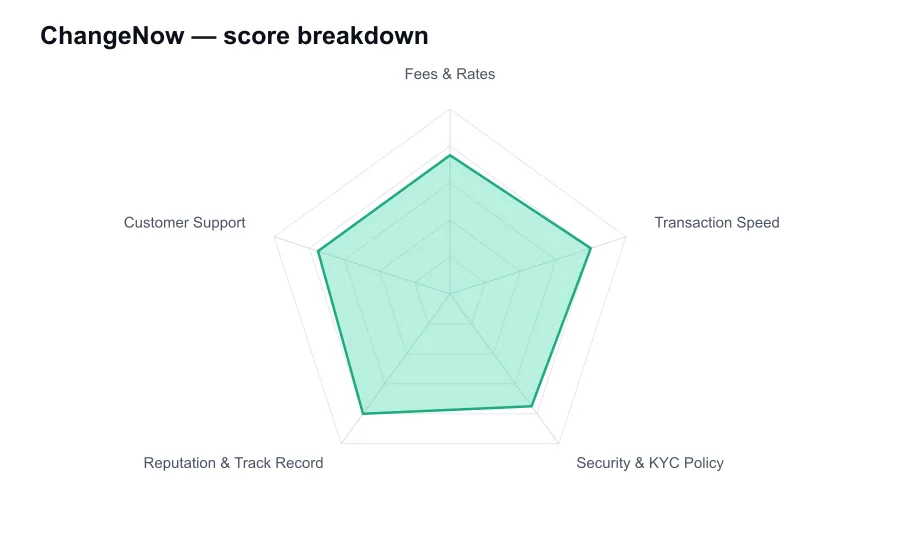
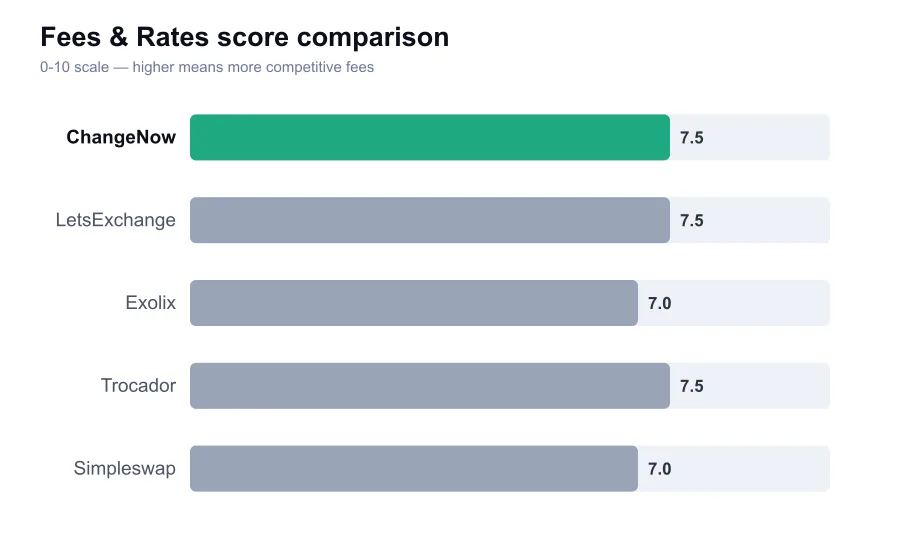
Fees are embedded in the quoted exchange rate. ChangeNOW does not operate like a spot venue that charges a plainly listed maker or taker fee on top of an observable market price. Its revenue can include liquidity-provider spreads, exchange-rate margin, and network costs. That model is not deceptive by itself. It becomes expensive only if users fail to compare the final amount they will receive.
The right way to judge a ChangeNOW quote is brutally simple. Open the same pair and amount on ChangeHero, SimpleSwap, StealthEX, and a major exchange if you have access to one. Compare the net output after all fees. ChangeNOW is sometimes highly competitive, especially on common routes, and sometimes it is not. The quote is the product, so judge the quote rather than marketing language about low fees.
ChangeNOW supports both floating-rate and fixed-rate transactions on eligible routes. The floating option usually offers a better initial number, but it exposes the received amount to movement between quote generation, deposit confirmation, and execution. Fixed-rate exchanges are more useful during volatility or on slower chains. They can look slightly worse at first glance, yet they remove the nasty surprise of sending Bitcoin and receiving materially less because the market moved while confirmations accumulated.
Transaction speed is one of ChangeNOW's stronger points. On well-supported, liquid pairs, the system can complete a swap quickly once the incoming chain has enough confirmations. A transfer on Tron or another fast network may feel almost immediate. Bitcoin deposits, Ethereum congestion, destination-wallet maintenance, and low-liquidity assets are different stories. The company cannot bypass a blockchain's confirmation rules, and customers should not expect it to.
Its broad asset coverage is a genuine selling point. ChangeNOW advertises access to a large selection of cryptocurrencies and networks, including popular coins, stablecoins, and a long tail of smaller assets. That breadth is useful, but it introduces network risk. USDT, USDC, ETH, and wrapped tokens can exist on multiple chains. Sending the right ticker on the wrong chain is one of the most common and expensive mistakes users make.
The compliance policy is more serious than some users expect from an account-light service. ChangeNOW uses automated risk screening and can request KYC or source-of-funds information for suspicious transactions. The company has publicly defended this approach as part of its anti-money-laundering obligations. That is understandable, but it has generated complaints from users who believed no-sign-up meant no possibility of verification.
My criticism is not that ChangeNOW screens transactions. Any sizeable centralized swap service that did not would be a red flag. The criticism is that the customer experience can feel harsh if a hold occurs after a deposit has already been made. A user with urgent funds may find that a swap becomes a compliance case. If you cannot tolerate that possibility, use a self-directed on-chain protocol where appropriate, or use a regulated exchange with verification completed before you trade.
Security is decent for this type of business. ChangeNOW has a long enough operational history, a visible public brand, and mature enough integrations to rate above obscure instant exchangers. It also offers a permanent swap address feature for repeat use, though I would treat any reusable deposit workflow with care. Addresses and network requirements should always be verified from the active order screen.
Support is available around the clock through chat and ticket-style channels, and the company is more visible publicly than most rivals. In routine cases, that helps. In difficult cases, the quality of the answer matters more than the existence of a chat bubble. Users should provide an order ID and transaction hash immediately, state the exact asset and network, and avoid sending duplicate deposits while waiting for an answer.
Reputation is strong for the instant-exchange niche, though not spotless. ChangeNOW has handled a large volume of consumer swaps over many years and has developed a recognizable presence. It has also attracted public complaints about AML freezes, delayed orders, and rate discrepancies, which are recurring weaknesses of the business model rather than unique evidence of failure. A mature reviewer should acknowledge both facts.
I would use ChangeNOW for a normal, non-urgent swap if its live quote is competitive and the route is clear. It is especially handy for self-custody users who need a broad asset selection without opening another exchange account. I would not use it as a place to park money, and I would not send a life-changing amount through any instant exchanger without first testing the route.
ChangeNOW earns its position near the top of this niche because it is established, fast on common routes, and genuinely convenient. The price for that convenience is less fee transparency than an order-book exchange and the possibility of post-deposit compliance review. Those are material drawbacks, not footnotes. Still, among instant swap providers, it is one of the more credible choices if you use it with sensible caution.