Coins Lantern logo Coins Lantern

LetsExchange

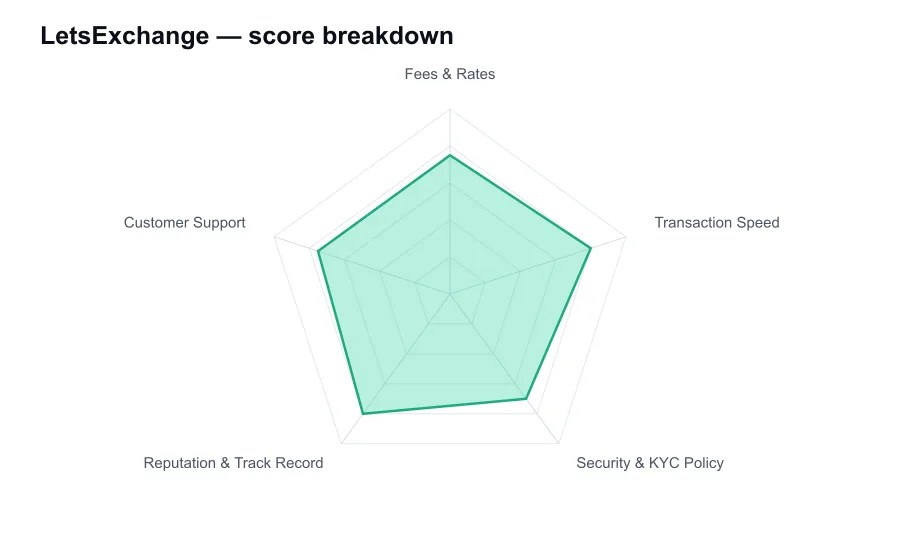
LetsExchange scores 7.6/10 overall in our independent review, measured against every other provider we've compared, strongest on Transaction Speed (8.0/10) and weakest on Security & KYC Policy (7.0/10).

Score: 7.6 How we score → Status: active (checked 2026-10-13T18:34:32.384Z)

Editorial independence: our scores and rankings are produced using the fixed criteria above and are not influenced by advertisers. This is an independent ranking site and is not operated by, or affiliated with, any provider we list.

Affiliate disclosure: some links on this page may earn us a commission at no extra cost to you. This does not affect our rankings.

Quick Verdict

LetsExchange is one of the more credible choices in the instant-swap category because it combines useful rate controls with a broader operational footprint. The fixed-rate option is genuinely valuable, and the broad routing coverage can produce attractive quotes. Its pricing still needs to be judged transaction by transaction, because there is no such thing as a free liquidity route. It is a strong convenience service for wallet users, provided they understand that instant exchange does not mean trustless exchange. I would choose it ahead of many smaller swap sites, though not ahead of a regulated exchange for major capital. Score: 7.6 How we score →
Best forNot for
Fixed-rate and floating-rate options —
Broad cross-chain asset coverage —
No conventional account needed for standard swaps —
API and wallet integration ecosystem —
Stronger public footprint than many instant exchangers —

What is LetsExchange?

LetsExchange is an instant crypto exchange aggregator that routes wallet-to-wallet swaps through liquidity providers. Users can exchange supported cryptocurrencies without using a traditional trading account. Eligible routes offer a choice between floating and fixed exchange rates.

Criteria Breakdown

Scoring breakdown for LetsExchange
Criterion Score Notes
Fees & Rates 7.5 No simple extra service fee, compare final quotes
Transaction Speed 8.0 Efficient routing, subject to chain confirmations
Security & KYC Policy 7.0 No standing balances, compliance review remains possible
Reputation & Track Record 8.0 Established operation with integrations and visibility
Customer Support 7.5 24/7 contact channels and useful order support

Key Facts

Key facts for LetsExchange
Fact Value
Service type Crypto-to-crypto exchange aggregator Source
Rate options Fixed and floating on eligible pairs Source
Account requirement Not required for standard swaps Source
Integration options API and partner wallet integrations Source
Support availability 24/7 support channels Source

How LetsExchange Works

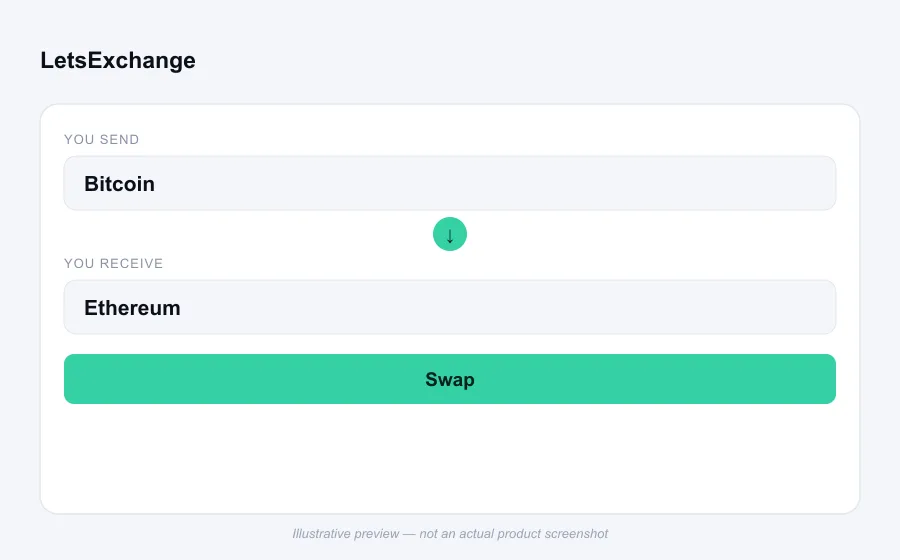
  1. Choose the asset, amount, and network you want to send
  2. Choose the payout asset and destination network
  3. Select a floating or fixed rate if both are offered
  4. Enter and verify your receiving wallet address
  5. Send the quoted amount to the provided deposit address
  6. Track confirmations and receive the payout

KYC

Requirementoptional
NotesStandard swaps generally do not require account registration. LetsExchange may apply compliance screening and request information on transactions that are flagged.

Supported Assets

Notable CoinsBitcoin, Ethereum, Solana, Litecoin, XRP, USDT, USDC, BNB
NetworksBitcoin, Ethereum, TRON, Solana, BNB Smart Chain, Polygon

How to Use LetsExchange Safely

Editorial Review

LetsExchange is one of the more developed instant-exchange aggregators in crypto. It offers wallet-to-wallet swaps across a large selection of coins and networks, then sources execution through liquidity partners rather than asking customers to trade on a conventional order book. In practical terms, it is closer to a quote-comparison routing service than to a centralized exchange such as Kraken or Coinbase.

The service has grown beyond the bare minimum swap widget. LetsExchange offers floating and fixed-rate options on eligible routes, affiliate and API tools, and integrations that put its exchange function inside third-party wallets and crypto products. That broader infrastructure focus gives it more substance than a small anonymous swap page. It does not eliminate counterparty risk, but it does suggest a more established operation.

For the normal user, the flow remains easy. Pick the assets, choose their respective networks, set the amount, enter a destination address, and send the deposit. LetsExchange shows available rate options before you commit. There is no need to create a conventional trading account for a standard exchange, which is a major reason people use it instead of a full centralized platform.

The fee story requires more attention than the marketing phrase often used by aggregators. LetsExchange has said it does not charge an additional service fee in the simple sense, but that does not mean swaps are free. The final rate incorporates costs from liquidity partners, market spread, and network fees. A user should ignore vague zero-fee impressions and compare the final number of coins received. That is the only price that matters.

This model can work well. On popular routes, LetsExchange can gather competitive quotes from several liquidity sources and sometimes beat a single-provider instant exchanger. On other routes, particularly thin assets or stressed networks, the quote may be unremarkable. I like that the site makes rate selection a visible part of the process. It encourages users to look at the actual execution terms rather than blindly accepting a default.

Fixed-rate swaps are one of LetsExchange's strongest practical features. A fixed order locks a quoted output for a defined payment window, subject to the customer sending the required amount correctly and on time. That is useful if you are paying an invoice, rebalancing a wallet, or simply don't want Bitcoin confirmation delays to change the result. Fixed rates are not available on every pair, and the locked quote may be less favorable than the floating one, but the choice is valuable.

Floating-rate orders are better for users who prioritize the most current available market rate and can tolerate movement. They can produce a better result if the market moves in your favor, though they can just as easily do the opposite. LetsExchange explains the distinction more clearly than many rivals. That may sound minor, but a lot of dissatisfaction with instant exchangers comes from customers who didn't understand which type of rate they chose.

Speed is generally good for liquid routes. LetsExchange can begin routing a transaction once the deposit reaches required confirmations, and many non-Bitcoin swaps finish in a short period after that point. Still, it is not magic. A congested Ethereum transaction, a low-fee Bitcoin withdrawal, or a token requiring extra liquidity sourcing can make the experience slower. The platform is quick relative to manually trading and withdrawing from a full exchange, but chain conditions remain the ceiling.

LetsExchange's asset and network coverage is broad. That is useful for users who need to exchange assets across ecosystems, such as moving from Bitcoin to a stablecoin on Tron, or converting an ERC-20 token into an asset on another supported chain. The danger is that a broad catalog can encourage careless assumptions. USDC, USDT, ETH, and wrapped versions of major coins may exist on several networks. The network selector is as important as the coin selector.

On security, LetsExchange has the usual strengths and limits of an instant-exchange model. It does not operate as a place where users need to leave a permanent balance. Customers provide a receiving address and make a transaction for a particular order. However, the deposit passes through the service's execution process, so this is not a decentralized atomic swap. You are trusting the provider and its partners to complete the exchange correctly.

KYC is generally not required for ordinary usage, but the platform reserves compliance controls for suspicious activity or legal requirements. That is the sensible way to describe it. No-KYC for routine flows does not mean a customer has a contractual right to complete every transfer anonymously under every circumstance. Anyone whose coins may trigger sanctions, fraud, or stolen-funds screening should expect the possibility of a hold and should not use an instant exchanger as a workaround.

LetsExchange has a stronger reputation profile than many small swap brands. It has operated for several years, has a visible commercial presence, has built third-party integrations, and is regularly included in exchange comparisons. That does not put it on the same trust level as a major regulated exchange with public financial reporting. It does mean there is more evidence of a sustained business than there is for a freshly launched anonymous site.

Customer support is available around the clock through live-chat and ticket-style channels. It has a more substantial help presence than many rivals, including order tracking and explanations for common issues. The important qualifier is that support quality matters most in difficult cases. Wrong networks, missing memos, delayed deposits, and compliance reviews can still be slow because the service may depend on external liquidity partners. The support team can coordinate, but it cannot always instantly reverse blockchain mistakes.

I would place LetsExchange near the top of the instant-exchange category for users who value choice, wide coverage, and a clear fixed-rate option. It is not automatically the cheapest service, and it is not the right venue for active traders who need order-book liquidity or advanced order types. For ordinary self-custody swaps, though, it is a more credible option than many obscure alternatives. Check the live quote, choose the rate type deliberately, and keep realistic expectations about network confirmation time. Used that way, LetsExchange is one of the better tools in its class.
Pros & Cons

ProsCons
Fixed-rate and floating-rate options —
Broad cross-chain asset coverage —
No conventional account needed for standard swaps —
API and wallet integration ecosystem —
Stronger public footprint than many instant exchangers —

Verdict

LetsExchange suits self-custody users who want to compare rates, select fixed execution where available, and access a wide range of assets and networks. It is particularly useful for wallet users making occasional cross-chain conversions. Active traders, users needing fiat deposits, and institutions seeking regulated custody should use a full exchange instead. Beginners should slow down and confirm the network for every token transfer.

Does LetsExchange charge a separate service fee?

LetsExchange presents itself as not adding a simple separate service fee, but the final rate can include liquidity-provider costs, spread, and network fees. Compare the receive amount.

Is KYC required on LetsExchange?

Routine exchanges generally do not require account registration or standard KYC. Compliance checks can still apply to transactions that trigger screening or legal requirements.

What is the difference between fixed and floating rates?

A fixed-rate order locks the quoted output for a limited payment window if you send the correct amount on time. A floating-rate order settles using the market rate during processing.

Why is a fixed-rate swap sometimes less favorable?

A fixed quote includes protection against adverse market movement during the payment and confirmation period. That protection can make its initial displayed rate less attractive than a floating quote.

Can I exchange tokens across different networks?

LetsExchange supports many cross-chain routes, but availability depends on the chosen assets and networks. Always select the exact network for both the deposit and payout token.

What happens if my deposit is delayed?

Processing begins after the required network confirmations. Bitcoin congestion, low transaction fees, and exchange withdrawal delays can affect timing and may matter for fixed-rate payment windows.

Does LetsExchange hold my assets in an account?

No conventional customer trading balance is required for a standard swap. Funds are still handled during the transaction, so users should view it as an intermediary, not a trustless protocol.

IM
Iris Montrose Consumer Crypto Markets Research Editor
Iris Montrose has spent nine years covering retail trading platforms, payment products, and digital asset markets. She tests exchange flows from a customer's point of view, reads the small print most people skip, and focuses on whether a platform is genuinely usable after the marketing claims wear off.
  • 9 yrs fintech and crypto journalism
  • Retail trading platform tester
  • Former payments industry reporter
  • Consumer risk research specialist
LetsExchange score breakdown by criterion, shown as a radar chart
Score breakdown
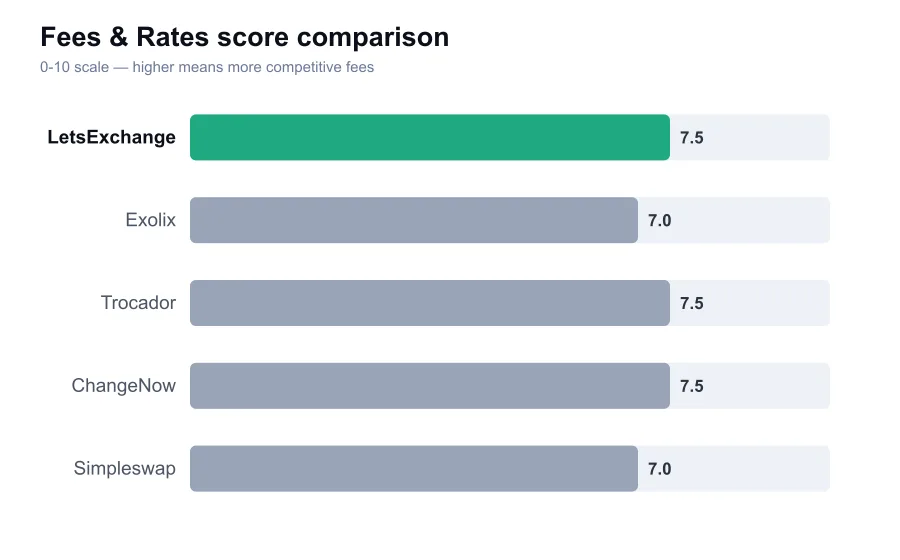
LetsExchange fees score compared against similar providers
Fees vs. alternatives
Illustrative swap flow preview for LetsExchange - not an actual product screenshot
Illustrative swap flow preview

Alternatives to LetsExchange

Alternatives to LetsExchange
AlternativeScore
Exolix Review7.6/10
Trocador Review7.5/10
BitcoinVN Review7.5/10
ChangeNow Review7.7/10
Simpleswap Review7.4/10
EasyBit Review7.2/10