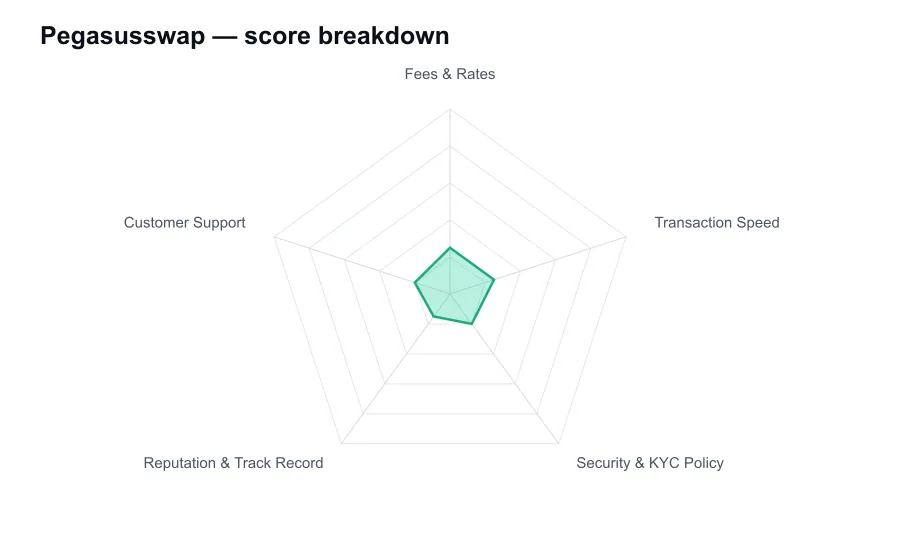
Pegasusswap is presented as a crypto swap provider, but it sits in the least reassuring part of the market: the small, lightly documented exchange brand with little independently verifiable history. Crypto has no shortage of polished conversion pages. What separates a service worth using from one worth avoiding is not the ability to produce a quote. It is whether the operator can show who runs it, how it handles funds, what it charges, and what happens when a transaction fails.
Pegasusswap has not built that level of confidence publicly. There is no broadly recognised corporate profile, long-standing industry reputation, substantial body of independent customer reporting, or security programme that puts it alongside established swap services. A site can look professional and still be operationally fragile. In crypto, users should be particularly sceptical of brands whose public story begins and ends with their own marketing copy.
The usual pitch for a swap provider is speed and convenience. Instead of opening an account at a centralised exchange, passing identity checks, learning an order book, and waiting for withdrawals, a user enters two wallet addresses and sends funds. That can be genuinely useful. It also concentrates risk into one irreversible action. Once coins have been sent to the provider's deposit address, the user is dependent on the provider to honour the quoted trade.
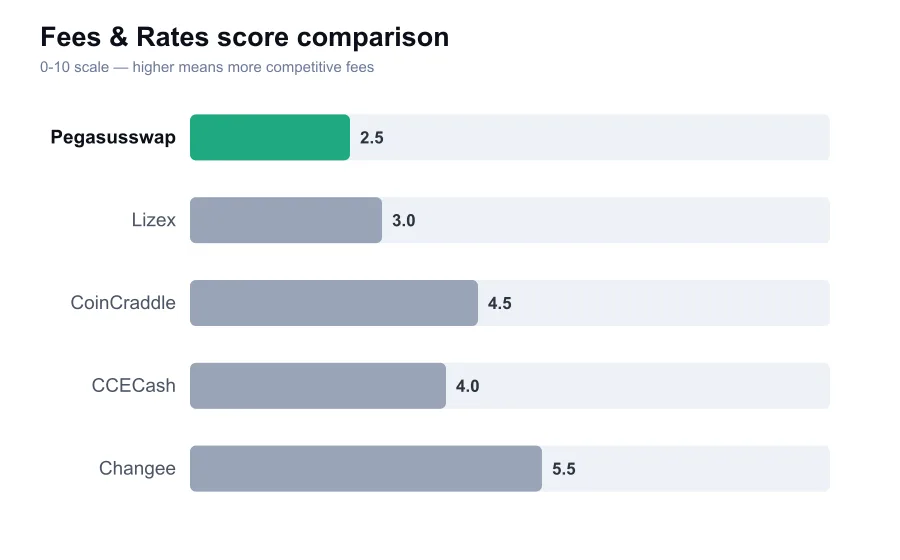
Pricing is impossible to praise without a transparent fee policy and a reproducible quote history. Pegasusswap does not have a widely accessible, detailed public fee schedule that lets a customer separate the service charge from the exchange-rate spread and chain fee. That is a serious flaw. A conversion service should make it easy to see whether the amount at checkout is fixed, estimated, or subject to repricing after deposit confirmation.
A poor quote is a fee even if the interface displays zero percent. Users should take the quoted receive amount and compare it against at least two established alternatives at the same moment. This is especially important for BTC, ETH, USDT, and other liquid assets where comparable routes are easy to find. If Pegasusswap is offering a much better rate than every credible competitor, that is not automatically a bargain. It is a reason to slow down and ask how the route is funded.
There is no solid public evidence base for judging Pegasusswap's normal transaction speed. Any service can complete a simple swap quickly when deposits confirm, liquidity is available, and no review is triggered. The real test is the exception: a delayed Bitcoin transaction, a congested EVM network, a customer who sent a token on the wrong chain, or an order whose quoted rate moved sharply. Reliable providers document these cases. Pegasusswap has not established that degree of operational clarity.
A provider's technology claims should be treated cautiously where public technical detail is scarce. A simple swap interface does not reveal whether deposits are held in segregated wallets, whether payout systems use cold-storage controls, how private keys are protected, or whether third-party liquidity partners have access to customer information. Users cannot inspect every backend control, but they can demand more than generic statements about safety.
There is no well-known public proof-of-reserves programme, audited security assessment, or longstanding bug-bounty record associated with Pegasusswap. Such evidence would not eliminate risk, but its absence gives users little basis for assessing custody practices. The correct response is not panic. It is risk management. Do not send a meaningful sum to an operator that has not demonstrated the resilience and accountability expected of a financial intermediary.
Identity verification and compliance policy are also unclear enough to matter. Some swap platforms create the impression that no personal information will ever be requested because the initial order flow does not require registration. In reality, many reserve the right to halt an order and demand identification if automated screening flags a deposit. A service can lawfully do that, but customers deserve plain-language terms before funds are committed. Pegasusswap has not earned confidence through a deeply documented public policy.
That ambiguity carries a higher cost for anyone using coins with a complicated transaction history. Funds previously linked to high-risk services, decentralised protocols, gambling, ransomware reports, or sanctioned addresses can cause screening problems. Even innocent users can be caught by flawed heuristics. A credible provider needs to explain how a customer can appeal, what evidence may be requested, and whether funds remain recoverable if the requested documents cannot be supplied.
Reputation is the decisive issue here. Pegasusswap does not have a well-developed public track record comparable to the better-known instant exchange providers. There are no years of visible service updates, major third-party reviews, independently discussed incidents, or a large body of credible user experience that would justify a generous score. Trust is earned slowly in this category because a successful small swap tells you much less than a responsible response to a difficult one.
Support is inseparable from that reputation problem. A support email address, chatbot, or social account is not a reliable dispute-resolution system. Customers need confirmation that a human can access transaction records, identify a stuck order, and explain what will happen next. I could not find the kind of sustained public evidence that shows Pegasusswap is strong at these tasks. For that reason, users should assume that a difficult case may take time and may be hard to escalate.
Pegasusswap is not a service I would recommend for a first crypto purchase, a large trade, a payment deadline, or a business conversion. There are enough established alternatives that accepting this level of uncertainty is unnecessary. A user who is determined to try it should send a tiny test amount, use a standard supported asset, and verify every detail independently. Never allow a promotional rate or an urgency message to override that discipline.
My final view is blunt. Pegasusswap has not supplied enough publicly verifiable evidence to justify significant trust. Its potential convenience does not compensate for unclear fees, limited security disclosure, an undeveloped reputation, and uncertain support depth. Until the business becomes far more transparent and builds a documented record over time, it belongs in the category of services to test cautiously, not services to rely on.