CoinCraddle appears in the instant crypto exchange segment, a market full of services that promise frictionless conversion between coins without the account setup of a major centralized exchange. The proposition is familiar and attractive. Select a pair, provide a receiving address, send the source asset, and wait for delivery. The harder question is whether the operator has earned enough trust to handle an irreversible deposit.
For CoinCraddle, that question remains central because its public operating profile is limited. A polished exchange page and a broad token selector are easy to build. A dependable service takes years of completed orders, responsive support, clear legal disclosures, stable liquidity relationships, and evidence that difficult cases are resolved fairly. CoinCraddle has much less publicly verifiable material than the leading names in the category.
That does not automatically prove bad conduct. It does mean a careful reviewer should resist filling the gaps with optimism. Crypto users have seen too many short-lived swap sites advertise easy conversion, then become unreachable when a transaction is delayed. The burden should be on CoinCraddle to show who operates it, how it prices orders, and how customers can obtain a refund if a route fails.
The user flow is likely familiar to anyone who has used an instant exchanger. Choose the input and output assets, enter a destination wallet, accept a quote, and fund a temporary deposit address. The provider or its partners then execute the conversion. This is simpler than order-book trading, but it puts the customer in a weak position after the deposit is broadcast.
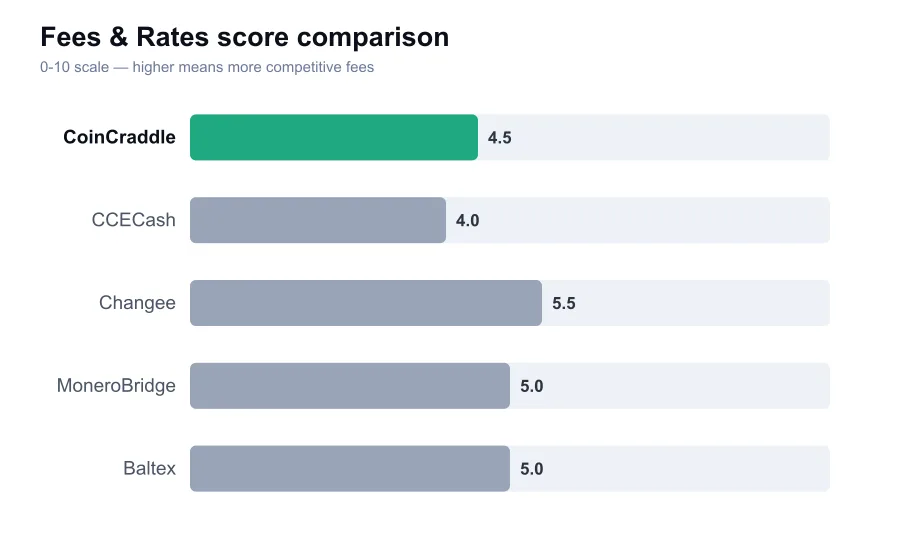
Fee disclosure is the first place I would scrutinize. Instant exchangers commonly present a receive amount rather than a fully itemized bill. Their margin can be embedded in the conversion rate, while network fees and liquidity costs move with conditions. That is a valid commercial model if the quote is competitive and explained honestly. It is a poor model if a site uses vague language about low fees while offering an uncompetitive net result.
CoinCraddle does not have enough independently documented fee data for me to call it cheap. The sensible approach is to run a side-by-side comparison with ChangeNOW, ChangeHero, and a liquid centralized exchange. Use the exact same source amount and chain. If CoinCraddle's final output is not clearly better, there is little reason to accept extra uncertainty from a less established counterparty.
Speed claims deserve the same skepticism. A swap can be fast because the source chain is fast, the asset is liquid, and the provider has available inventory. It can be slow because Bitcoin needs confirmations, Ethereum gas spikes, a liquidity partner is unavailable, or an order is manually reviewed. CoinCraddle has not built the public record required for me to treat a speed claim as reliable under difficult conditions.
Do not make a time-sensitive transfer through an unproven instant exchanger. If a payment deadline, liquidation risk, or bridge transfer depends on the output arriving promptly, choose a route with more predictable execution. A major exchange account, a reputable decentralized exchange, or a direct on-chain swap may involve more steps, but it can offer better visibility into what is happening.
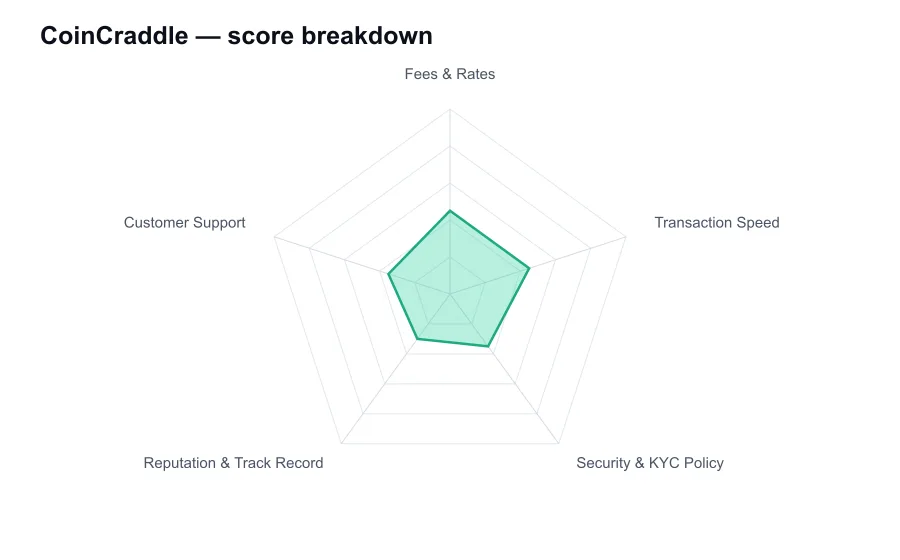
Security requires more than HTTPS and a wallet-address form. Customers need protection from phishing, clear domain ownership, secure handling of temporary deposits, sensible compliance procedures, and a support team that can identify an order without asking users to expose unnecessary information. Publicly accessible detail around CoinCraddle's controls and policies is not strong enough for a high security score.
KYC is another potential trap for users who assume an instant exchange is anonymous. Any centralized service that touches a deposit can screen it. If CoinCraddle flags an address or transaction, a customer may find the funds held while additional documents are requested. Before using any provider, read the terms governing reviews, refunds, and prohibited activity. If those terms are missing or vague, walk away.
Reputation is the weakest part of the CoinCraddle case. There is no substitute for sustained, independently observable operation. A provider can have a functional website and still lack the transparency that a customer should demand before transferring valuable digital assets. I would rank CoinCraddle substantially below established instant exchangers until it develops a clearer track record.
Support should be treated as something to test, not assume. Send a specific question before depositing, such as whether a particular stablecoin network is supported, what happens after an incorrect memo, or whether a rate can be fixed. A good team answers directly and identifies its policy. A weak team responds with generic sales language or fails to reply at all.
The risk management advice here is simple. Use a new receiving address you control, conduct a small test, verify the output amount, and keep records. Never send all of an asset balance to an unfamiliar provider because the first quote looks attractive. A minor rate improvement cannot compensate for a disputed or delayed transaction.
CoinCraddle may be usable for an experienced person testing a very small conversion, but that is the ceiling of my recommendation. It has not established the transparency or reputation needed to compete confidently with older brands. There are enough alternatives in crypto swaps that users do not need to take this particular leap of faith.
My final view is cautious rather than dramatic. CoinCraddle's category is useful, and the service model can solve a real problem. Yet its limited public evidence changes the risk calculation. Until the company offers clearer pricing, verifiable operating information, and a stronger support record, it should remain a low-value test option rather than a regular exchange route.