Lizex presents itself as a cryptocurrency exchange service, but it occupies a troublingly obscure corner of the market. It doesn't have the public history, regulatory visibility, independently reviewed trading infrastructure, or recognisable operating company that experienced crypto users expect before sending funds. That doesn't automatically make it fraudulent. It does mean a user has to treat every transaction as high risk until basic questions about custody, ownership, fees, and support are answered directly and convincingly.
The first problem is simple: there is very little durable, independently verifiable information about Lizex. Established exchanges leave a trail. You can find corporate registrations, leadership profiles, product documentation, security reports, app-store histories, meaningful customer discussion, and years of archived website material. Lizex doesn't have that kind of record. A thin public footprint is especially concerning for a financial service that asks customers to transfer irreversible assets.
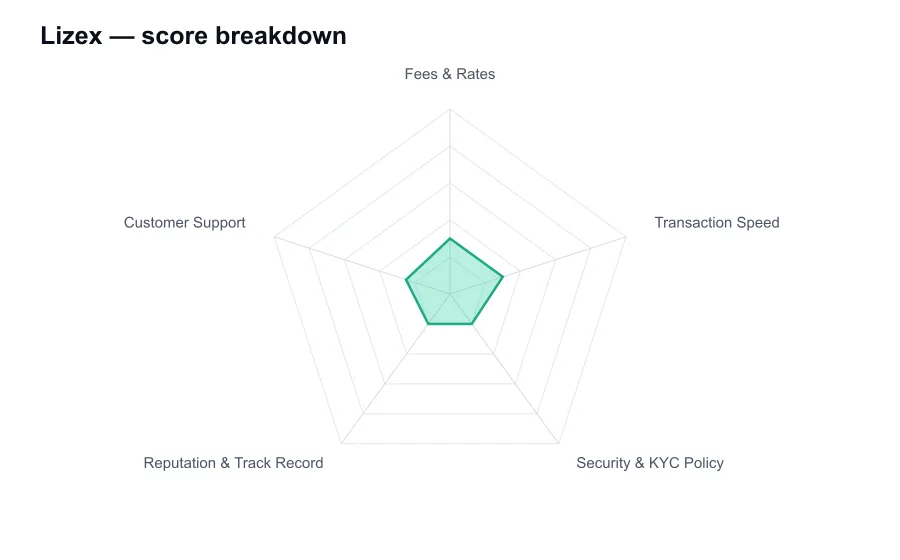
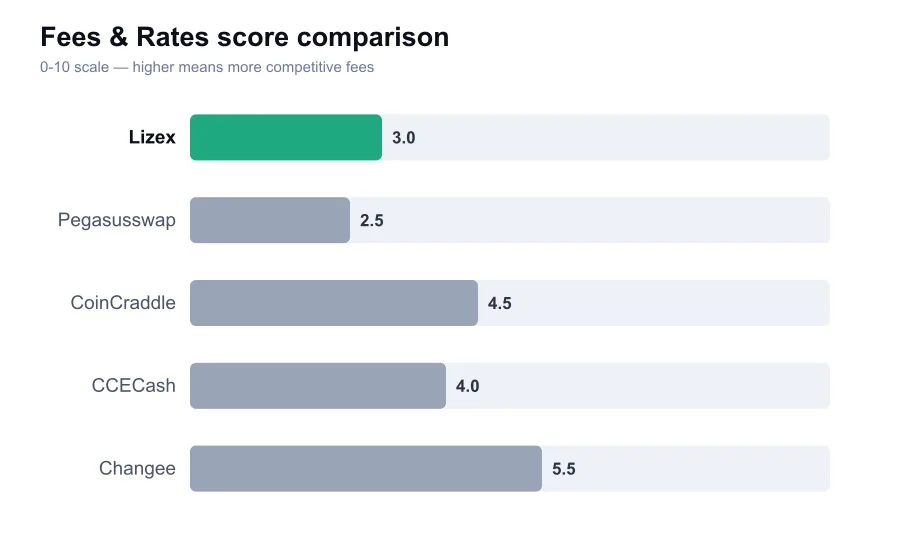
Its fee presentation is not strong enough for a reviewer to confidently calculate the cost of a trade before funds are sent. A credible instant exchanger should explain whether its quoted rate includes a service spread, network fee, partner-liquidity markup, or a fixed service commission. Lizex has not established a widely accessible, detailed fee schedule that can be independently checked. That leaves users comparing a headline quote without knowing whether the final amount is competitive.
This matters more than many buyers realise. An exchange can advertise no visible fee and still earn a meaningful margin through a poor conversion rate. The only useful comparison is the amount received after all deductions against live quotes from established services such as ChangeNOW, FixedFloat, Kraken, or a major decentralised exchange. If Lizex's quote is materially worse, the absence of a stated fee is no comfort at all.
Transaction speed is similarly difficult to assess because there is no extensive body of verified user evidence establishing normal settlement times. Swaps are rarely instant in the literal sense. A Bitcoin transaction may wait for confirmations, an Ethereum transaction can be delayed by gas conditions, and liquidity providers can hold an order for manual checks. A serious provider says what confirmation threshold it uses and what customers should expect if an order gets stuck. Lizex has not built confidence through that kind of clear operational documentation.
The security issue is larger than speed or pricing. Crypto exchange users need to know whether they are dealing with a non-custodial order-routing service, a custodial broker, or a conventional exchange retaining balances. Those models carry very different risks. If a service generates a deposit address and forwards funds through a liquidity partner, its security depends on its backend controls and on the partners it selects. If it retains user deposits, customers need evidence of wallet segregation, withdrawal controls, and reserve management.
Lizex does not offer the level of transparent security disclosure that would let a prudent customer assess those risks. There is no widely recognised public audit programme, proof-of-reserves publication, bug-bounty history, or detailed explanation of key custody that I could rely on. Smaller providers do not need to imitate every feature of Binance or Coinbase, but they do need to show customers who holds funds, how incidents are handled, and who is accountable if money goes missing.
KYC is another area where ambiguity is a practical drawback. Many instant exchange services advertise a low-friction experience, then reserve the right to request identity documents or source-of-funds evidence when an automated compliance system flags a transaction. That policy can be legitimate, especially where blockchain-risk screening is involved. The issue is whether customers are told in advance what can trigger a hold, what documents may be requested, and how long a review normally takes. Lizex has not earned trust through a clear, publicly established policy here.
That uncertainty is particularly dangerous for privacy-focused assets or funds arriving from decentralised finance protocols, mixers, gambling services, or high-risk counterparties. A customer may think a swap is complete once the deposit has been broadcast, only to find that the service wants additional information. Since blockchain transfers cannot be recalled, the provider's communication quality during a review becomes the difference between an inconvenience and a serious loss event.
Reputation is Lizex's weakest category. There is no mature record of surviving major market cycles, handling public incidents transparently, or building a base of credible long-term user reviews. New services can be good, but they should be judged more strictly than businesses that have processed years of public-facing customer complaints and kept operating through volatility. With Lizex, the lack of evidence is not neutral. It is a reason to limit exposure.
Customer support is hard to score generously for the same reason. A contact form or messaging channel is not enough when an exchange holds a time-sensitive transaction. Users need a documented ticket path, a transaction identifier system, response expectations, and staff capable of tracing deposits across chains. There is no broad, reliable record showing that Lizex resolves delayed swaps or compliance holds consistently. Until such a record exists, support should be assumed to be limited rather than dependable.
I would not use Lizex for a large conversion, emergency transfer, payroll payment, or any transaction where timing matters. It might be tempting if a quoted rate looks unusually attractive, but unusually attractive rates are exactly where extra scrutiny is needed. Test services like this only with an amount you can afford to lose or leave tied up while you seek an answer from support.
A careful test should start with a small, ordinary asset pair on a well-supported network. Save the quoted output, deposit address, transaction hash, timestamps, and every support message. Do not send funds from an exchange account if a delay would interfere with a withdrawal deadline. Avoid smart-contract routes and wrapped assets until the service has demonstrated that it can handle a basic transaction correctly.
Lizex may eventually develop a clearer public identity and stronger operating record. Right now, its limited transparency is too substantial to dismiss as a cosmetic issue. Crypto users have plenty of alternatives with published terms, known teams or legal entities, deeper liquidity relationships, and visible support histories. A low-friction exchange is useful only if the operator can be trusted when the friction finally appears.